 Justin van Oel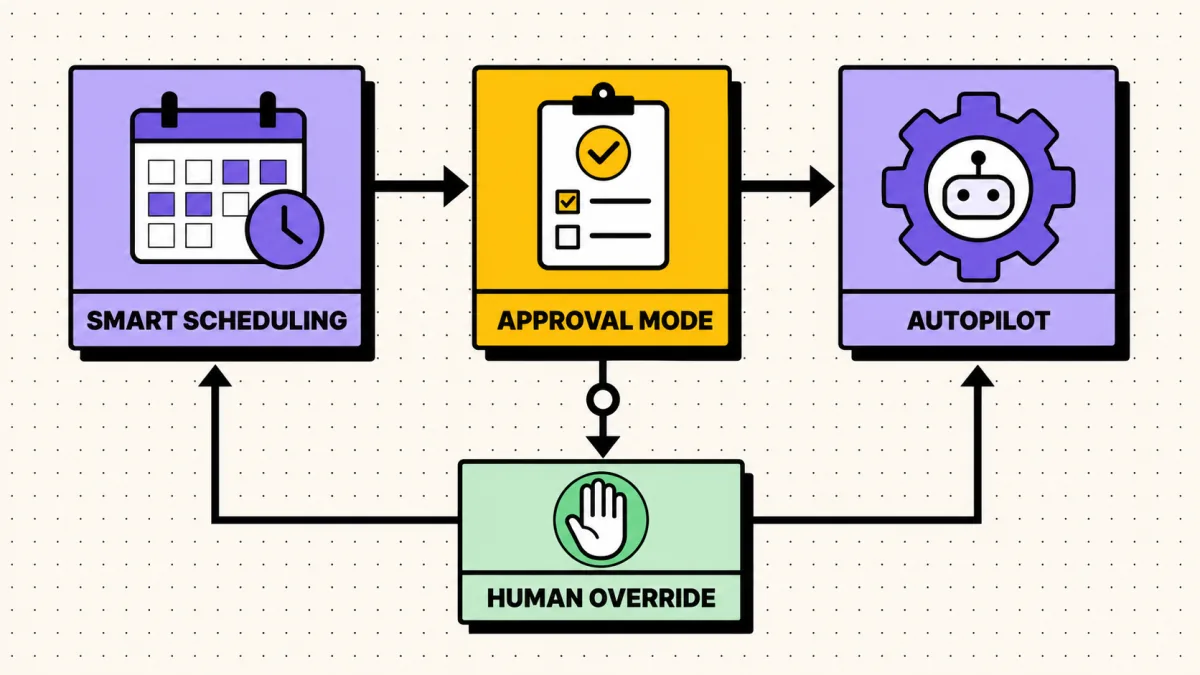
AI Autopilot vs. Scheduling Social Media: Two Different Bets on Automation
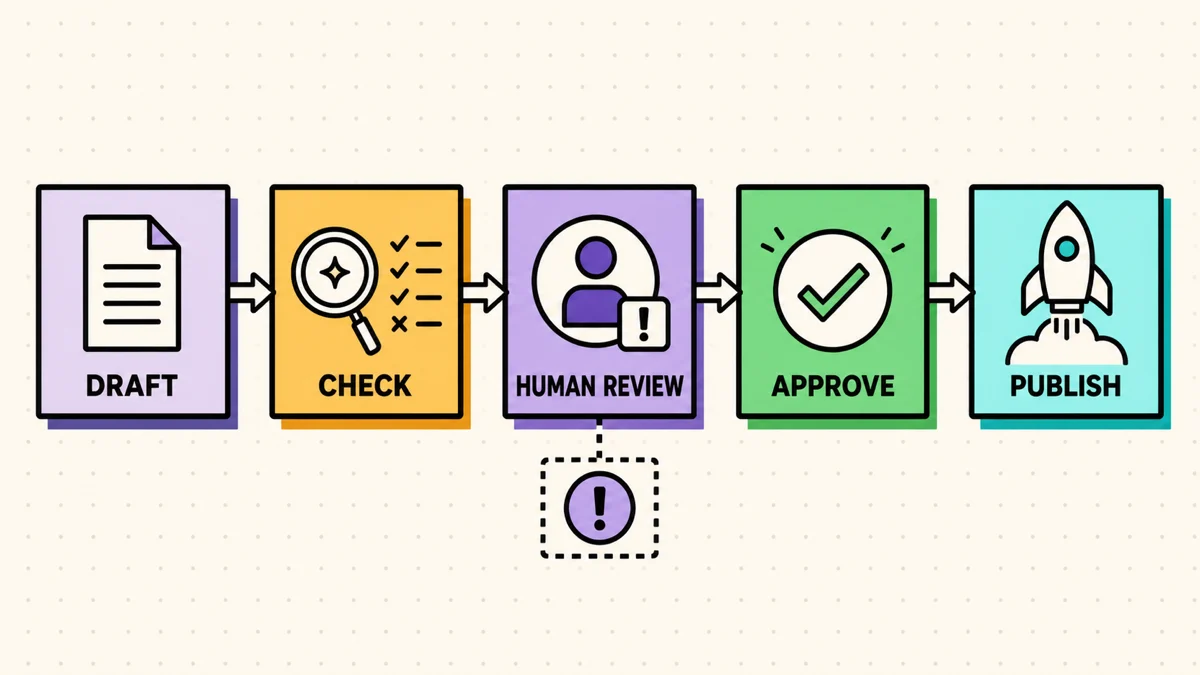
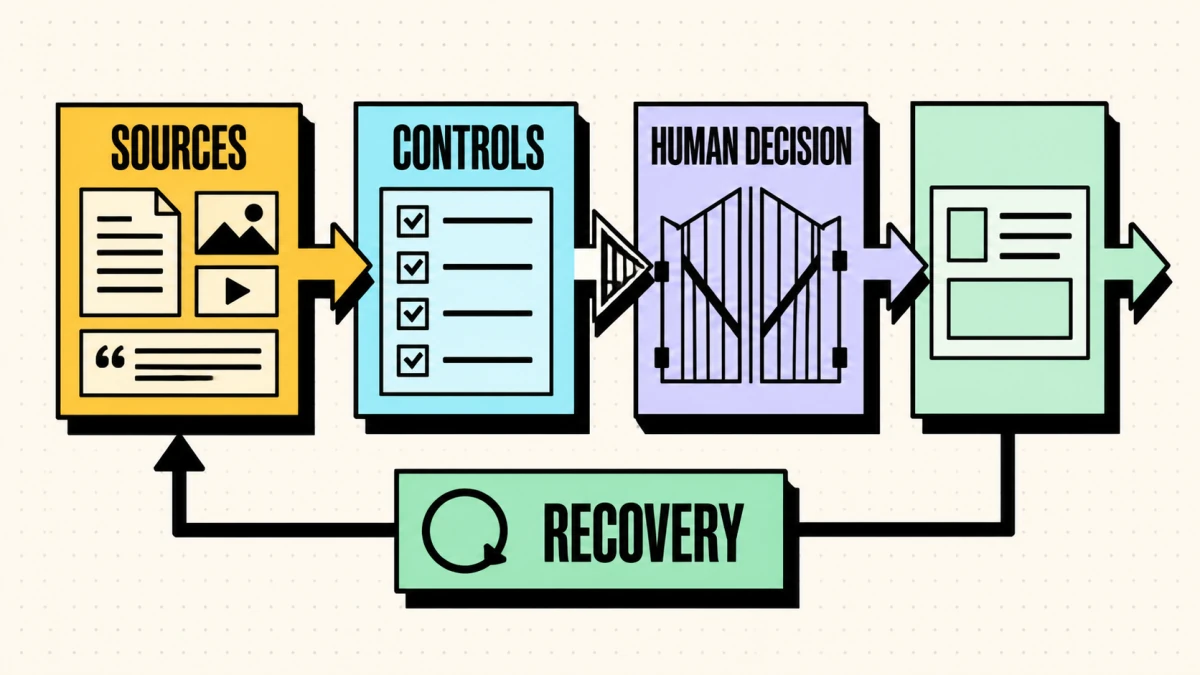
Choosing between scheduled publishing, approval mode, and a higher-autonomy workflow is an operating-model decision. Define which judgments the system may make, what evidence it needs, when a person must review, and how the team detects and recovers from failure.
The risks differ. A stale scheduling queue can leave planned channels empty; a higher-autonomy workflow can publish a poorly supported or badly timed claim if its context and controls are weak. Evaluate consequence, reversibility, review, and recovery rather than treating either model as inherently safe.
The complete guide to B2B social media marketing places automation inside the wider editorial workflow.
What scheduled publishing does—and where capabilities overlap
Smart scheduling is content management with timing intelligence. You create or approve the content; the platform optimizes when it publishes. That's the core value proposition, and it's a meaningful one.
A scheduling-only workflow coordinates prepared content; it does not solve an empty editorial queue. Current products do not fit a clean category boundary: Buffer, Hootsuite, and Sprout all document AI-assisted post generation alongside scheduling. Compare the specific plan and workflow rather than relying on a category label.

Turn your brand context into social drafts
Turn your brand context into platform-aware social drafts for your connected channels. Start free, no credit card.
Brand-context controls also vary. Some products use selected prior social posts or connected social data; others accept prompts, guidelines, documents, or structured source context. Inspect the actual inputs, review controls, supported media, and destinations instead of assuming a scheduler has no generation or voice features.
What AI Autopilot Actually Means (and Where It Carries Risk)
A higher-autonomy workflow can generate content from supplied context and may publish eligible work without per-post human approval when configured to do so. The strategic upside is significant, particularly for teams managing a high channel count or operating across multiple markets.
The risk depends on the autonomy granted, the quality of the current context, the content class, the destination, and the available safeguards. A team should define when human approval is required and when an appropriately configured higher-autonomy workflow may operate.
One possible configuration is AI-assisted generation with an approval queue for defined content classes, plus higher autonomy only where current context, risk criteria, destination support, and recovery controls justify it. That structure captures the efficiency gains while preserving oversight where it matters.
The AI content governance guide explains the control layer around this decision. The question isn't whether to use AI autopilot; it's whether the governance layer around it is robust enough to make autonomous posting a calculated decision rather than a default.

The Core Trade-Off: Control vs. Throughput
The honest framing of the AI autopilot vs. scheduling social media decision is a control-versus-throughput trade-off. Neither model dominates across all conditions.
| Dimension | Scheduling-led workflow | Higher-autonomy workflow |
|---|---|---|
| Content generation | May be separate or included; verify the plan | Generated from supplied context within product allowances |
| Brand context | Capability and inputs vary by product | Requires current, reviewable context and correction paths |
| Human approval | Prepared content may still require review | Approval posture and scope vary; verify the actual control |
| Capacity constraint | Drafting, review, and queue maintenance | Source maintenance, review, exceptions, and recovery still consume capacity |
| Risk | Depends on claim, evidence, destination, timing, and reviewer | Adds autonomous-action risk when controls or context are weak |
| Destination variants | Manual or assisted, depending on product | May be generated where the destination and post type are supported |
| Failure mode | Empty or stale queue; wrong timing or configuration | Unsupported claim, stale context, blocked state, or failed publish |
The table makes the structural difference visible. Smart scheduling is a distribution layer. AI autopilot is a content operation layer. Teams often need to decide which constraint they're actually solving for before choosing.
When Autonomous Posting vs. Scheduled Content Is the Wrong Binary
Many corporate teams reach this decision point and treat it as either/or. That framing leaves value on the table.
A professional-services firm managing LinkedIn presence for ten regional offices faces a different problem than a B2B SaaS company running a single brand across six platforms. The first organization has a coordination problem: getting consistent, on-brand content produced and approved across distributed teams. The second has a volume and consistency problem: maintaining a credible publishing cadence without burning out a small marketing team.
For the first scenario, reviewed brand context plus an approval queue can centralize the decision without pretending every region is identical. For the second, a higher-autonomy posture may increase draft throughput, but the team should measure edit effort, blocked states, and publishing outcomes before treating it as an efficiency gain.
The multi-platform publishing guide shows where both scenarios converge: content that needs to exist in multiple formats, adapted for platform norms, published on a consistent cadence. That's where the operational leverage of AI autopilot becomes most concrete.
How AI Learns Brand Voice (and Why It Matters for This Decision)
Brand context is one important input alongside model behavior, brief quality, source freshness, destination constraints, and human review. Inspect whether a product uses current, reviewable sources and whether editors can correct the resulting context. Then measure voice fit and substantive edit effort rather than assuming improvement.
Reviewed source context and a correction loop can make recurring problems easier to diagnose. Measure substantive edit effort over time rather than assuming that drafts automatically converge on the intended voice.
The guide to brand voice consistency across channels explains how to turn broad voice language into reviewable rules. If editors cannot apply those rules consistently, adding autonomy will not resolve the ambiguity. The AI autopilot decision often surfaces a prior problem worth solving regardless of which automation model the team chooses.
When to Use AI Autopilot: Conditions That Justify the Shift
AI autopilot earns its place under specific operational conditions. Knowing when those conditions are met is more useful than a general recommendation.
Demand exceeds editorial capacity. When channel demand exceeds available drafting and review capacity, measure missed slots, substantive edit time, approval delay, and failed publishes before increasing automation.
Content with a defined, acceptable risk. Classify risk by claim sensitivity, volatility, audience, destination, evidence, reversibility, and consequence—not by a format label such as “evergreen” or “product update.”
Reviewable context with feedback loops in place. A higher-autonomy workflow needs current sources, explicit voice guidance, and a way to flag, investigate, and correct recurring failures.
Distributed or global teams. When content needs to be produced across time zones and regional teams, an approval-mode workflow can centralize review without removing oversight.
The social media content calendar guide provides a visibility layer for automation configurations. It provides the visibility layer that keeps distributed teams aligned on what's been published, what's queued, and where gaps exist.

Evaluating Platforms: What to Look For Beyond the Feature List
Comparing automation platforms on features alone misses the operational variables that determine whether a tool delivers sustained value.
Approval workflow scope. Verify the level at which each product can change review posture. FlyingToast’s publishing mode is currently organization-level, with platform-specific cadence and configuration; it does not claim campaign- or channel-level approval modes.
Analytics that inform the automation. Best-time recommendations and platform-level performance breakdowns feed back into scheduling and generation decisions. Platforms that surface this data in context, rather than requiring export and analysis, reduce the operational overhead of optimization.
Per-platform content adaptation. Publishing the same post to LinkedIn, X, and Instagram without adaptation is a brand-voice problem as much as a formatting one. Platforms that generate per-platform variants as part of the automation loop reduce the manual editing that erodes the efficiency gains.
Trial access without commitment. Evaluate the workflow with current brand materials, then inspect source use, voice fit, substantive edits, review states, and publishing constraints. A trial without a credit card lowers the commitment required for that test.
FlyingToast, for context, builds reviewable Brand Knowledge from supplied source material, creates platform-aware variants for supported workflows, and offers approval and Autopilot behavior according to the selected plan and organization configuration. The 14-day trial does not require a credit card. Current flat-plan prices, channel allowances, approval availability, and generation quotas are listed on the pricing page.
Whether it is the right fit depends on destination support, editorial capacity, review needs, and whether reviewable brand context adds value beyond scheduling logistics. Teams whose main constraint is scheduling coordination may find a simpler workflow sufficient.
Measuring the Right Outcomes After You Commit
Choosing an automation model is the beginning of the decision, not the end. The value of either approach depends on which outcomes the team observes and how honestly it attributes them.
For smart scheduling, the relevant metric is publishing consistency relative to team capacity. If the queue runs dry regularly, that's a signal that the throughput constraint hasn't been solved.
For AI autopilot, the relevant metrics are voice consistency over time, approval cycle duration, and engagement performance relative to manually produced content. Teams that track these systematically can make informed decisions about where to expand autopilot and where to keep humans in the loop.
Measuring social media ROI for B2B marketing teams Measuring social media ROI for B2B marketing teams is where this operational data connects to business outcomes. Automation that improves publishing consistency without evidence of better engagement or pipeline contribution has not demonstrated strategic value; it has demonstrated operational efficiency at best.
The distinction matters for budget conversations. Marketing leaders who can demonstrate that AI autopilot improved both throughput and engagement performance have a stronger case for investment than those who can only show time saved.
The Decision Framework
Neither automation model is universally superior. The right choice depends on where the team's constraint actually sits.
If the constraint is distribution and timing, a scheduling-led workflow may address it with less operational change, while still carrying configuration, timing, and review risk. If the constraint is content generation, voice consistency, and throughput at scale, AI autopilot with appropriate governance is the higher-leverage investment.
Scheduling and AI-assisted generation solve different problems. Scheduling coordinates approved content. A higher-autonomy workflow can assist with generation and publishing when current context, destination support, guardrails, and ownership are in place. Many teams will use both modes for different content classes.
Key takeaways:
- Smart scheduling optimizes distribution; AI autopilot addresses content generation and voice consistency at scale.
- The control-versus-throughput trade-off is the real decision, not a feature comparison.
- Autopilot earns its place when channel count is high, brand voice is documented, and governance structures are in place.
- Hybrid configurations (AI generation with approval queues) capture efficiency gains while preserving oversight for sensitive content.
- The right measurement framework connects automation choices to engagement and pipeline outcomes, not just time saved.