Brand voice drift: how to diagnose and reduce it across teams
A diagnostic method for comparing intended and published voice, finding drift, and correcting the upstream cause.
- Written by
- Justin van Oel
- Published
- Reading time
- 11 min
- Updated

In this article · 9 sections
Brand voice drift: what it is and how to diagnose it
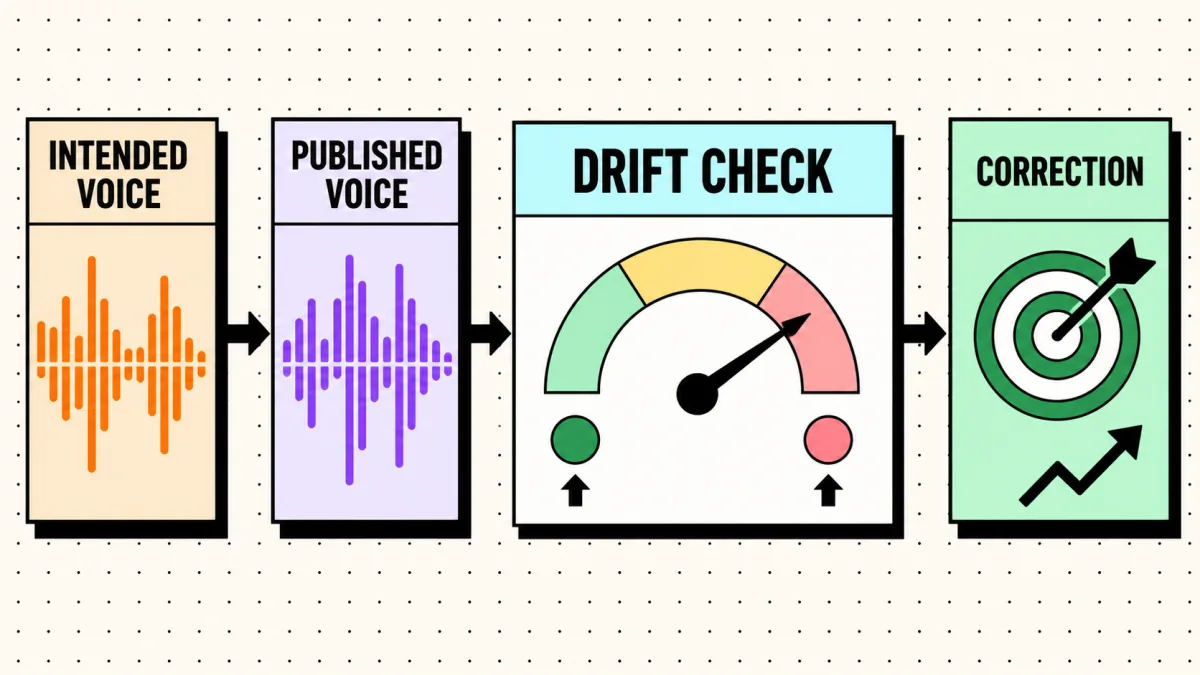
Brand voice drift is the gradual divergence between intended voice guidance and published content. It can arise through individually reasonable decisions made by contributors working from incomplete rules, examples, source context, or feedback.
Brand voice drift is more than a stylistic concern when it changes how an organization frames its expertise, audience, or product. Its business effect should be measured rather than assumed. The immediate editorial task is to identify the difference between intended and published voice and correct the upstream cause.
The guide to keeping brand voice consistent across social channels covers the core operating model. This article focuses on identifying drift and correcting its upstream cause.
What brand voice drift looks like in practice
Drift is not usually a dramatic shift. It is the accumulation of small departures that each seem reasonable in isolation. One writer softens the tone for a sensitive topic. Another adds humor that fits LinkedIn but not the brand. A third defaults to industry jargon because it feels authoritative. None of these decisions triggers an alarm. Together, they erode the coherent identity a brand spent years building.
A guidelines document can become an onboarding artifact rather than an active reference. Contributors read it once, internalize a rough approximation, and then write from memory. Over time, their individual approximations diverge.

Turn your brand context into social drafts
Turn your brand context into platform-aware social drafts for your connected channels. Start free, no credit card.
The clearest signals of drift to watch for:
- Tonal inconsistency: The brand sounds confident on LinkedIn, apologetic on X, and overly casual on Facebook. Audiences who follow across platforms experience a fragmented identity.
- Vocabulary slippage: Key brand terms get replaced with synonyms. "Clients" becomes "customers," "solutions" becomes "products," "partnership" becomes "vendor relationship." Each swap seems minor; the cumulative effect is a brand that no longer speaks its own language.
- Register mismatch: Some posts are written for a C-suite reader, others for a practitioner. Without deliberate calibration, the brand loses its sense of who it is talking to.
- Visual-verbal disconnect: When the written tone drifts away from the visual identity, the brand stops feeling coherent even to audiences who cannot articulate why.
Tonal inconsistency can be difficult to detect in isolated reviews because the pattern becomes clearer across a cross-channel sample.
Why brand voice drift can increase at scale
Additional contributors and destinations create more opportunities for inconsistent interpretation. The practical risk depends on the clarity of the rules, examples, ownership, review process, and feedback loop—not team size alone.
Several structural dynamics drive this acceleration.
Contributor fragmentation. Corporate social content is rarely produced by a single person. Agencies, regional teams, subject-matter experts, and in-house writers all contribute. Each brings a different baseline interpretation of the brand voice. Without a shared enforcement mechanism, the guidelines document alone cannot hold the line.
High publish frequency. As publishing volume rises, contributors have less time per draft unless capacity and process change with it. Review the relationship between volume, substantive edits, and approval delay rather than assuming a fixed trade-off.
Weak feedback loops. A review process may catch factual or compliance issues without testing tonal consistency. A post can pass legal review, manager approval, and a final proofread while still sounding nothing like the brand. The feedback loop that would catch voice deviation simply does not exist in many organizations.
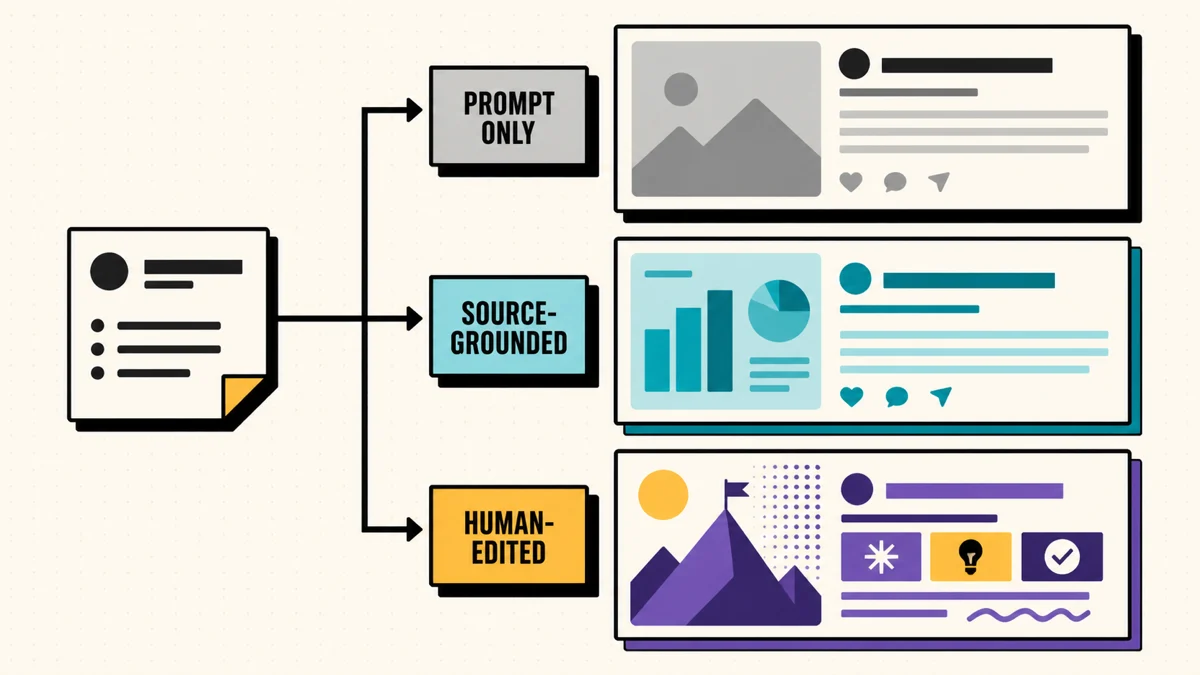
AI-assisted amplification. A generic brief or weak source context can produce plausible but interchangeable professional writing at greater volume. Our guide to why AI-generated social posts sound generic shows how to diagnose the missing source, distinction, instruction, or review loop.

Why generic voice guidance fails to prevent drift
Brand voice guidance that only describes broad traits is difficult to operationalize. They tell contributors what the brand sounds like in the abstract. They do not tell them what to do when the abstract collides with a specific post about a product update on a Tuesday afternoon.
A typical guidelines document includes adjectives: "confident," "approachable," "expert." These are directionally useful but functionally insufficient. "Confident" can mean assertive, or it can mean arrogant. "Approachable" can mean warm, or it can mean informal to the point of undermining authority. Without examples that demonstrate the distinction, contributors fill the gap with their own interpretation.
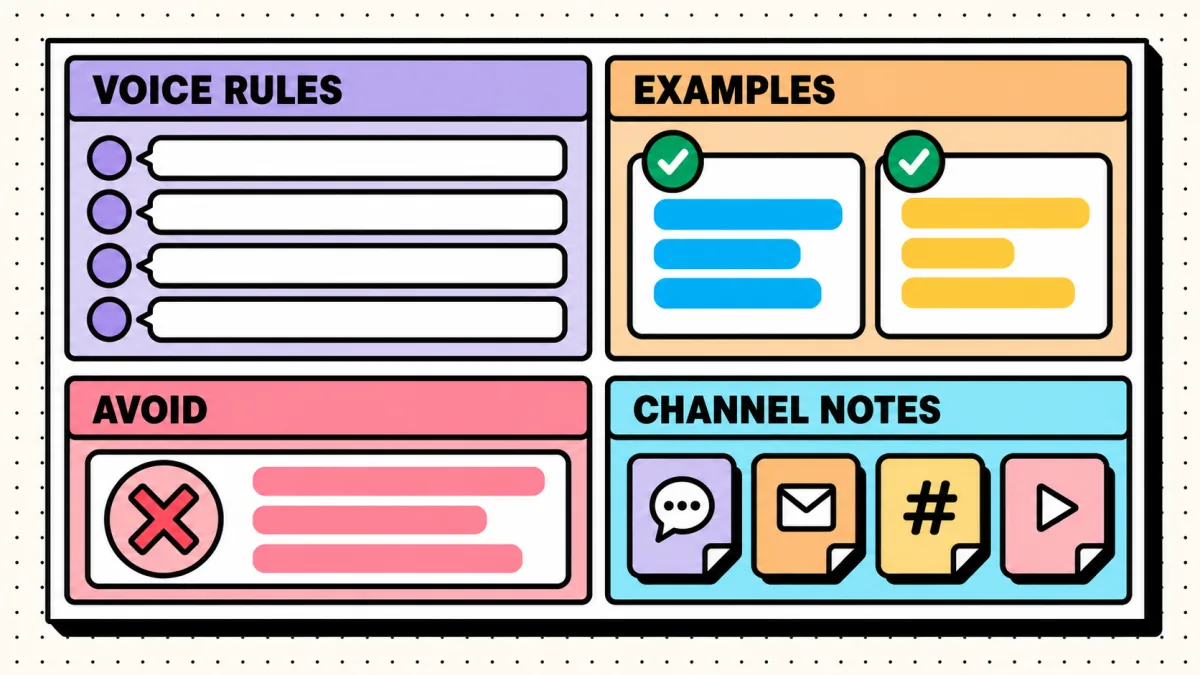
A practical approach is to treat brand voice guidance as a system with multiple layers:
Layer 1: Principles. The adjective-level description of the brand's character. Necessary but not sufficient.
Layer 2: Behavioral rules. Specific, testable instructions. “Prefer active voice unless a passive construction is deliberately useful.” “Do not use exclamation points in post copy.” "Refer to our audience as 'marketing leaders,' not 'marketers' or 'CMOs.'" These rules can be audited.
Layer 3: Examples with commentary. Pairs of "this, not that" content with explanations of why. This is the layer most guidelines documents omit, and it is the layer contributors actually need when writing under time pressure.
Layer 4: Platform-specific adaptations. The brand voice does not change across platforms, but its expression does. A LinkedIn post and a post on X require different register calibrations while remaining recognizably the same brand. Documenting those adaptations explicitly prevents contributors from inventing their own.
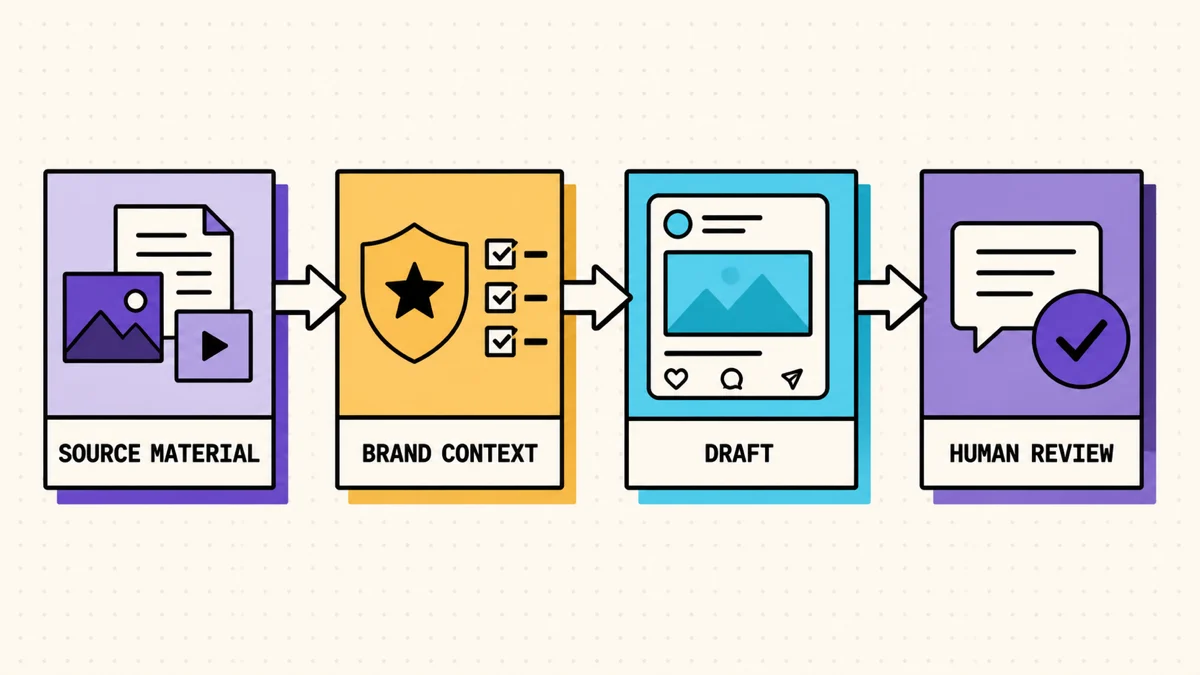
For AI-assisted generation, these layers can serve as reviewed generation context. Source specificity is one input to voice fit alongside the model, brief, examples, destination instructions, and review.
How to build a brand voice system that reduces drift
Preventing brand voice drift is not primarily a creative challenge. It is an operational one. The goal is to make the correct brand voice the path of least resistance for every contributor, at every volume level.
Step 1: Audit current output before writing new guidelines.
Pull a recent period of published social content that represents the active destinations, contributors, and content types. Read it as a body of work, not as individual posts. Document the specific points of inconsistency: vocabulary, tone, register, platform behavior. This audit defines the gap between the intended voice and the actual voice, which is the precise problem the guidelines need to solve.
Step 2: Write behavioral rules, not just descriptors.
Take every adjective in the current guidelines and convert it into at least two testable rules. If the brand is "authoritative," what does that mean for sentence structure? For the use of hedging language? For how claims are framed? Rules that can be applied mechanically are rules that scale across contributors.
Step 3: Build a reference library of approved examples.
Curate a representative set of posts that reflects the brand voice across relevant content types and destinations. Annotate each one. Explain why it works. This library becomes the practical reference contributors use when guidelines feel abstract, and it becomes reviewed example context for AI-assisted workflows.
Step 4: Integrate voice review into the approval process.
Most approval workflows are structured around accuracy and compliance. Adding a voice-check step, even a lightweight one using a short checklist derived from the behavioral rules, creates the feedback loop that catches drift before it publishes. The AI content approval workflow guide is a practical starting point for making that review explicit.
Step 5: Assign voice stewardship explicitly.
Someone needs to own the brand voice as an ongoing operational responsibility, not just as a one-time guidelines project. This person owns the review trigger, updates the example library, and serves as the escalation point when contributors have questions. Without explicit ownership, the system decays.
Step 6: Revisit guidelines on a defined cadence.
Brand voice is not static. Review the documentation when positioning, products, audiences, contributors, or recurring correction patterns change. A calendar reminder can help, but the review trigger should reflect actual change rather than a universal interval.
Maintain consistency when multiple teams contribute
The organizational complexity of enterprise social content is where even well-designed voice systems break down. Regional teams, agency partners, and internal subject-matter experts each have their own defaults, and they are often working under different incentives and timelines.
A central brand team may set guidelines without connecting them to content creation and review. The guidelines exist in a shared drive. Contributors know they exist. But under deadline pressure, the shared drive is not where writers go for guidance.
Several structural interventions close this gap.
Centralized content briefs. Rather than asking contributors to interpret the brand voice independently, provide a brief for each content series that includes the tone, vocabulary, and structural expectations for that specific context. Briefs reduce interpretive variance at the source.
Template libraries. Pre-approved post structures for recurring content types (product announcements, thought leadership, event promotion) give contributors a framework that is already voice-calibrated. The contributor fills in the specific details; the voice is built into the template.
Consolidated publishing infrastructure. When content from multiple contributors flows through a single publishing system with an approval queue, the brand team gains a consistent review point. Content that bypasses this infrastructure bypasses the voice check. Fragmented tooling is a structural enabler of drift. The multi-platform publishing guide explains how a shared source and review point can reduce this risk.
Regular calibration sessions. Working sessions triggered by meaningful change or recurring disagreement can help contributors review recent output, identify drift, and update the shared reference. These sessions also surface the edge cases that guidelines do not anticipate.
AI-assisted generation also needs explicit rules, reviewed examples, current sources, and destination guidance. Weak context can produce generic drafts, while stronger context still requires testing and review. The comparison of Autopilot and smart scheduling explains how review posture changes the workflow.

How to detect drift before it becomes a larger problem
Detection is as important as prevention. Even well-designed systems drift over time. The question is whether the drift is caught early, when correction is straightforward, or late, when the brand has already published months of inconsistent content.
Scheduled content audits. Use the behavioral rules to review a sample sized to publishing volume and risk. Expand the sample until the same material patterns recur, and trigger additional review when products, positioning, destinations, or contributors change.
Cross-channel comparison. Pull the same time period of content from each platform and read them side by side. Drift often manifests as platform-specific divergence: the brand sounds like one entity on LinkedIn and a different entity on Instagram. Cross-channel comparison makes this visible in a way that single-platform review cannot.
New contributor monitoring. Review new contributors more closely until they demonstrate consistent use of the documented rules, with explicit feedback against those rules.
Audience signal monitoring. Comments, replies, and direct messages sometimes surface voice inconsistency before internal audits do. Audiences who follow the brand closely notice when something sounds off, even if they do not frame it in brand-voice terms. Social inbox monitoring, as part of a broader analytics practice, provides this signal. Keep those audience signals distinct from the attribution framework in the B2B social ROI guide.
The goal of detection is not to catch contributors making mistakes. It is to identify where the system is failing to support them, and to fix the system.
The long-term effect of ignoring voice drift
Unaddressed drift creates more inconsistent examples and can normalize conflicting interpretations among contributors. A distinctive voice may support recognition and positioning, but its commercial effect should be measured rather than assumed. The immediate cost is editorial: more disagreement, repeated corrections, and less coherent published work.
The brands that treat voice consistency as an operational system rather than a creative preference are the ones that retain this advantage at scale. That means governance, not just guidelines. It means feedback loops, not just documents. And it means treating brand voice maintenance as an ongoing investment, not a one-time project.
The B2B social media guide, AI content governance framework, and content calendar guide provide complementary operating context.
Key takeaways
Brand voice drift is an operational problem: published content diverges from intended guidance through ambiguous rules, fragmented context, inconsistent review, or weak feedback loops. More contributors, destinations, or generated drafts create more opportunities for inconsistent interpretation, but they do not determine the outcome by themselves.
Preventing it requires moving beyond descriptive guidelines to operational systems: behavioral rules, annotated example libraries, integrated approval workflows, explicit voice stewardship, and scheduled detection audits. Maintaining voice consistency across a larger workflow depends on deliberate process design as well as editorial judgment.