All articles

Why AI-Generated Social Posts Sound Generic and How to Fix Your Brand Voice

AI-generated social posts sound generic when tools lack structured brand voice input. Here is how B2B teams build a repeatable system that fixes it.

Elise Hartmann Elise Hartmann 16 min read
Share
A B2B marketing team reviewing AI-generated social post drafts against brand voice guidelines

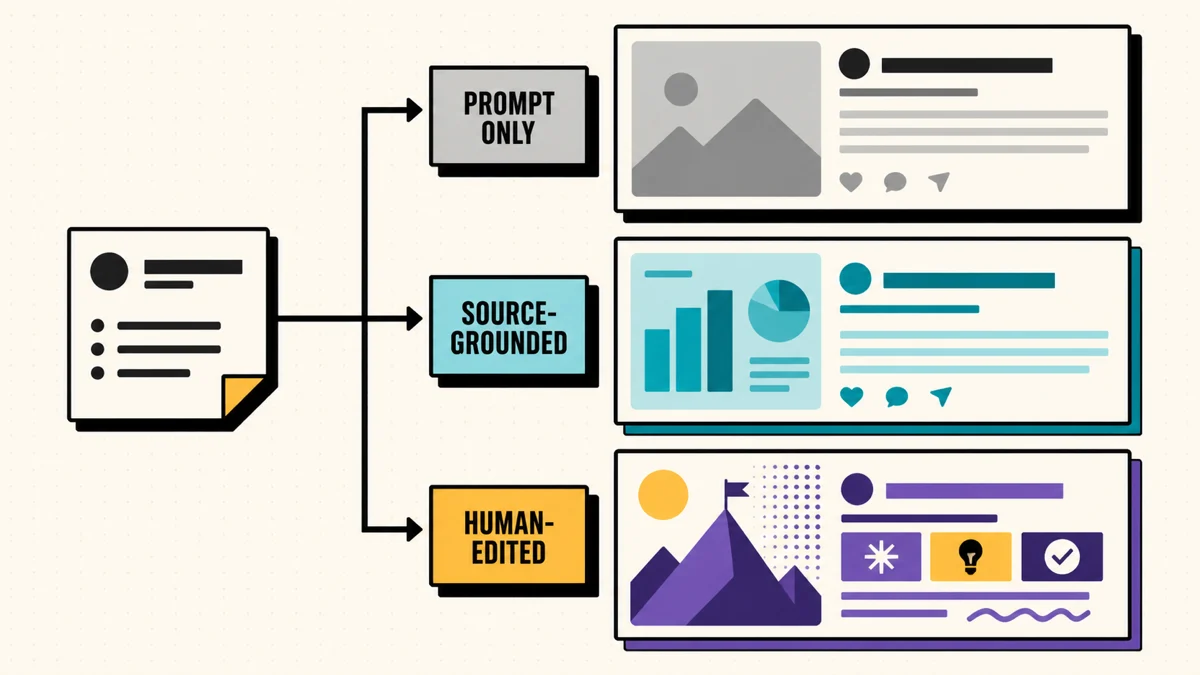
AI-generated social posts sound generic for a predictable reason: the model has no durable sense of who the brand is. Without structured brand input, AI writing tools default to the statistical center of everything they were trained on, which produces competent, inoffensive, and entirely forgettable output. The fix is not a better one-off prompt. It is a better brand voice system.

This guide walks through the mechanics of why AI flattens brand voice, what corporate marketing teams can do about it, and how to build a content operation where AI-generated posts actually sound like your brand. For broader context on how this fits into a full social strategy, read the complete guide to B2B social media marketing.

Short answer: AI-generated content sounds generic because the model fills missing brand context with the most statistically likely language. If the system does not include your audience, positioning, vocabulary, tone boundaries, proof points, and examples of good output, the AI defaults to safe, polished, average copy. The fix is not a longer prompt. The fix is a structured brand voice system that gives the AI repeatable inputs and gives reviewers a clear standard for approval.

What "Generic" Actually Means in AI Writing

Generic AI output is not bad writing. It is writing optimized for the average, which is the exact opposite of differentiated positioning. The posts are grammatically clean, structurally sound, and could have been written by any brand in any category.

This happens because large language models are trained to predict the most statistically probable next word across an enormous corpus. When you ask one to "write a LinkedIn post about our new product," it has no signal to deviate from the mean. It reaches for the patterns that appear most frequently in professional content: the rhetorical question opener, the three-bullet value proposition, the "excited to announce" construction.

Put your brand voice on autopilot

FlyingToast learns your brand voice and generates on-brand social posts across 13+ platforms. Start free, no credit card.

Start free trial →

The output is not wrong. It is just not yours.

For corporate brands managing dozens of channels, this is a compounding problem. Each post that sounds like every other brand in your space is a missed opportunity to build recognition and trust. Brand voice is a strategic asset, and generic AI output erodes it at scale.

Generic vs On-Brand AI Social Post Examples

Generic AI content usually fails in four places: it describes benefits without context, uses phrases any competitor could publish, avoids specific customer situations, and sounds polished without sounding owned. The difference between generic and on-brand output is rarely grammar. It is the amount of usable brand and audience context behind the generation.

Scenario Generic AI output On-brand output What changed
B2B SaaS launching a reporting feature "Our new reporting tool helps teams save time and make better decisions." "Your Monday report should not require three dashboards, two exports, and a follow-up meeting. Our new reporting view gives marketing teams one place to see what moved, what stalled, and what needs attention." Added audience, pain, specificity, rhythm, and concrete workflow language.
Corporate brand posting about AI content governance "AI governance helps teams use AI safely and responsibly." "If every team member can generate a post, every team member also needs the same rules for claims, tone, approvals, and escalation. Governance is not what slows AI content down. It is what keeps scale from turning into cleanup." Replaced abstract benefits with a sharper point of view and a specific operational risk.
Agency sharing a client win "We are excited to help our client improve their social media strategy." "The client did not need more posts. They needed a repeatable way to turn product updates, customer proof, and executive opinions into channel-specific content without rewriting the same idea five times." Removed generic announcement language and named the actual workflow problem.

These examples work because they give the AI something more useful than a mood. They provide audience context, a real situation, words the brand would use, and words the brand would avoid.## Why AI Defaults to the Middle: The Input Problem

The root cause of generic AI content is almost always an input problem, not a model problem. When the AI receives a vague instruction, it fills the gap with its training data defaults.

Consider the difference between these two prompts:

  • "Write a LinkedIn post about our Q3 product update."
  • "Write a LinkedIn post in a direct, slightly dry tone for a senior financial services audience. Avoid jargon. Lead with the business outcome, not the feature. Our brand never uses exclamation points."

The second prompt produces a meaningfully different result, not because the model is smarter, but because the instruction space is narrower. The model has less room to default.

Most marketing teams operate closer to the first prompt than the second, especially when volume is high. This is where systematic brand voice documentation becomes the real lever. A common pattern in enterprise content operations is that brand guidelines exist as a PDF somewhere, but they are never operationalized into the AI workflow. The guidelines describe the voice; the AI never sees them.

The solution is to treat brand voice as structured data, not a style guide that lives in a shared drive.

Why Better Prompts Are Not Enough

A stronger prompt can improve a single output. A brand voice system improves every output. That distinction matters for B2B teams because the cost of generic content compounds across campaigns, channels, and reviewers.

Weak approach Better approach
"Write this in our brand voice." Define what the brand voice means with approved examples, banned patterns, vocabulary, and audience context.
One prompt per post Persistent brand voice profile reused across campaigns and platforms.
Reviewer rewrites manually Reviewer feedback updates the voice rules that future generations use.
Same post for every platform Platform-specific variants with shared brand constraints.
Brand guidelines stored as a PDF Brand inputs embedded directly into the content workflow.

Prompts are still useful, but they should sit on top of a persistent system. Otherwise every new post depends on whoever wrote the instruction that day.## How Brand Voice Gets Lost in the AI Layer

Brand voice drift in AI-generated content follows a recognizable pattern. It rarely happens all at once. It accumulates through small defaults: a slightly too casual opener here, a corporate buzzword there, a call-to-action that no human on your team would actually write.

Many B2B teams report that the drift becomes visible only after a content audit, when someone reads six months of AI-assisted posts in sequence and realizes none of them sound like the brand. By then, the damage to channel consistency is already done.

Three specific mechanisms drive this drift:

Prompt decay. Teams start with detailed prompts, then simplify them over time as volume increases. Each simplification removes a constraint, and the AI fills the gap with defaults.

Context loss. AI tools without persistent brand memory treat every post as a new conversation. There is no accumulated understanding of what your brand has said before, what it would never say, or what its audience expects.

Reviewer fatigue. When approval queues are long, reviewers stop catching subtle voice issues. The bar shifts from "does this sound like us?" to "is this factually correct?" Voice consistency is the first casualty.

How to keep brand voice consistent across every social channel requires addressing all three mechanisms, not just improving prompts.

A marketing manager reviews social post drafts against brand voice guidelines on a large monitor

Step 1: Document Brand Voice as Machine-Readable Input

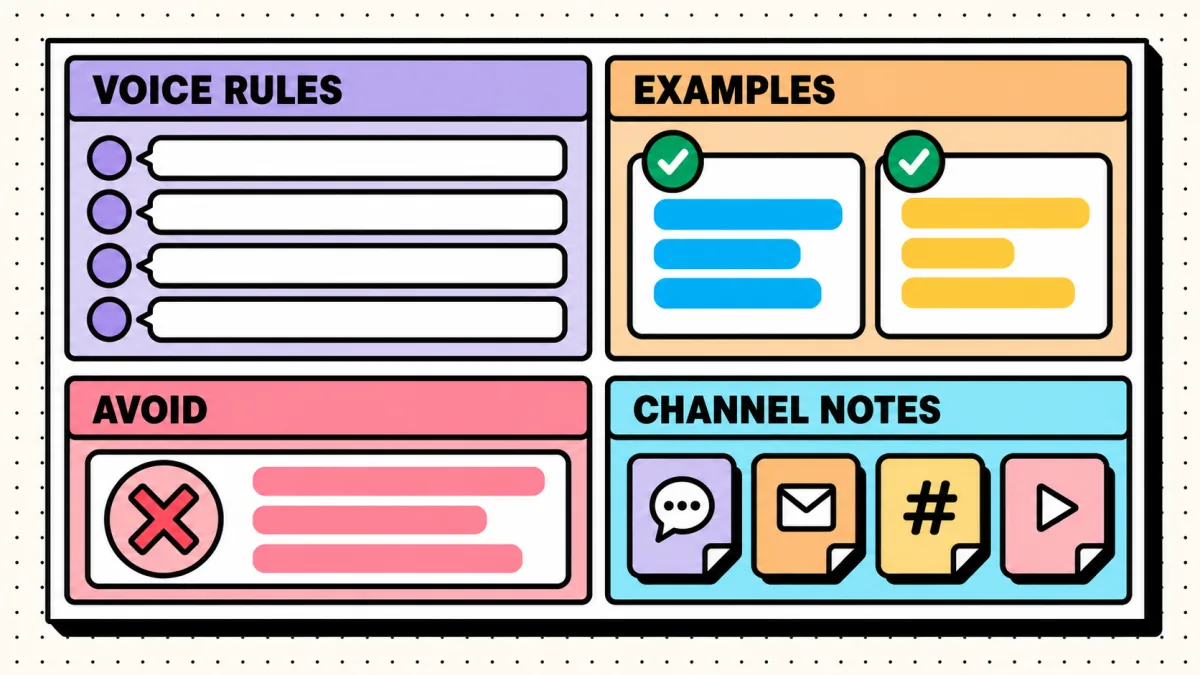
The first step to fixing generic AI output is converting your brand voice from a human-readable style guide into structured, machine-readable input. This means going beyond adjectives like "professional" or "approachable" and capturing the specific patterns that define your voice.

Useful inputs include:

  • Tone descriptors with examples. Not "we are direct." Instead: "We lead with the conclusion. We do not build to a point. See these three examples."
  • Anti-patterns. A list of phrases, constructions, and tones your brand explicitly avoids is often more useful than a list of what you do use.
  • Audience-specific registers. A financial services brand speaking to CFOs on LinkedIn and to operations managers on a community platform needs different registers. Document both.
  • Sample posts rated by quality. High-quality examples the AI can pattern-match against are more actionable than abstract descriptions.

The goal is to reduce the gap between what your brand sounds like and what the AI has to work with. The more specific the input, the less room the model has to default to the generic center.

AI Brand Voice Input Template

Use this template to turn a brand voice guide into input an AI writing system can actually use.

Brand position:
We help [audience] achieve [outcome] without [pain/friction].

Audience:
Our readers are [roles/team types]. They care about [priorities]. They are skeptical of [claims].

Voice principles:
1. We sound [trait], not [opposite].
2. We use [type of language/examples].
3. We avoid [banned phrases, hype, jargon].

Approved vocabulary:
Use: [terms, product language, customer phrases]
Avoid: [generic SaaS phrases, vague claims, internal jargon]

Proof points:
Mention these when relevant: [features, workflows, integrations, metrics, customer examples]

Platform guidance:
LinkedIn: [professional, strategic, specific]
X/Twitter: [compressed, sharper, conversational]
Instagram: [visual-first, simpler, more human]

Good examples:
[Paste 3-5 approved posts]

Bad examples:
[Paste 3-5 rejected posts and why]

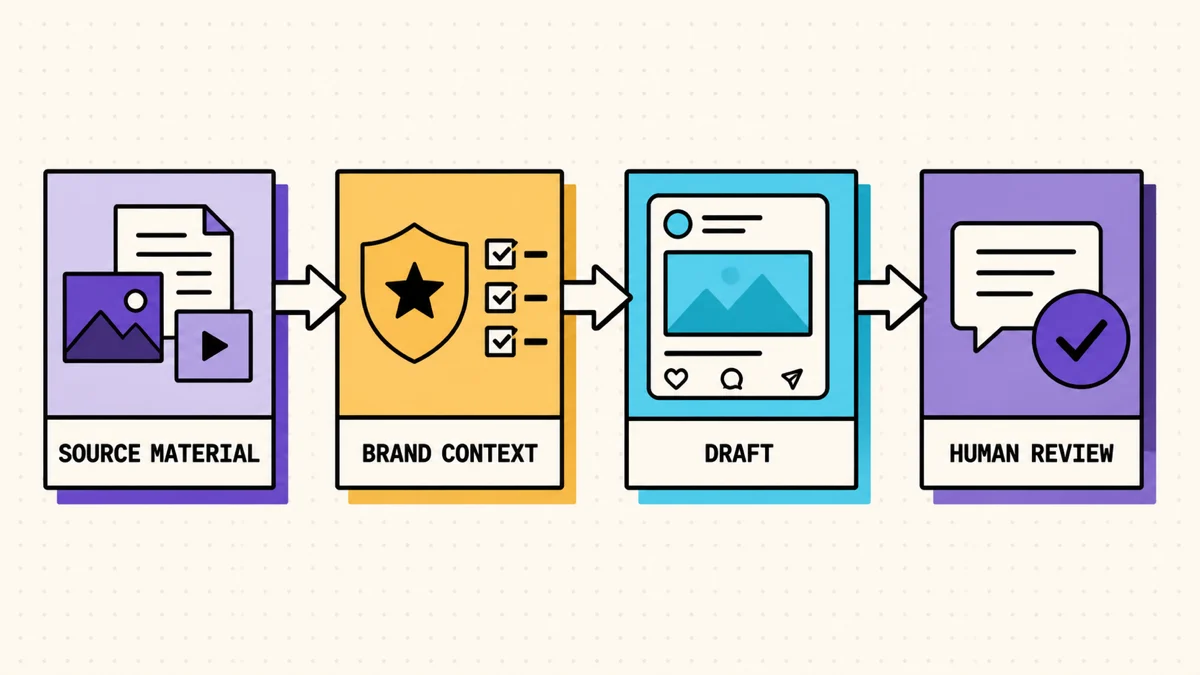
In practice, this template should not live in a forgotten document. For teams generating social content every week, these inputs need to become part of the content system itself: the brand profile, the approval workflow, the platform rules, and the feedback loop that improves future posts.## Step 2: Build Brand Voice Into the Workflow, Not Just the Prompt

Fixing individual prompts is a tactical intervention. Building brand voice into the workflow is a structural one. The structural approach compounds over time; the tactical approach requires constant maintenance.

A common mistake is treating brand voice as a prompt variable, something you add at the top of each request. This works at low volume. At scale, it creates inconsistency because different team members write different prompts, and the AI responds differently to each.

The more durable approach is to configure brand voice at the platform level, so every piece of content generated inherits the same voice parameters by default. AI social media automation platforms that support brand-voice learning from uploaded documents (brand guidelines, website content, existing posts) operationalize this at the system level rather than the prompt level.

This is also where approval workflows earn their keep. An approval queue is not just a compliance mechanism. It is a feedback loop. Reviewers who flag voice issues consistently are generating signal that can be used to refine the brand voice configuration over time. For teams building out this kind of editorial infrastructure, how to build a social media content calendar that runs itself covers how approval and scheduling layers fit together.

Step 3: Use Per-Platform Voice Variants, Not One-Size-Fits-All Output

Authentic AI content does not mean the same voice everywhere. It means the right expression of your voice for each platform's context and audience expectation.

LinkedIn tolerates longer-form, more formal content. X (Twitter) rewards compression and a sharper edge. A brand that sounds natural on LinkedIn often sounds stiff on Instagram, and vice versa. Generic AI output tends to flatten these distinctions, producing a middle-register post that fits nowhere perfectly.

The fix is to define per-platform voice variants as part of your brand documentation. Not a different brand voice, but a different expression of the same voice. Think of it as the difference between how a senior partner speaks in a board presentation versus how they write an internal Slack message. The values and perspective are identical; the register is calibrated to the context.

Multi-platform publishing workflows that support per-platform content variants make this operationally feasible at scale without requiring manual rewriting for every channel.

Step 4: Establish a Voice Calibration Feedback Loop

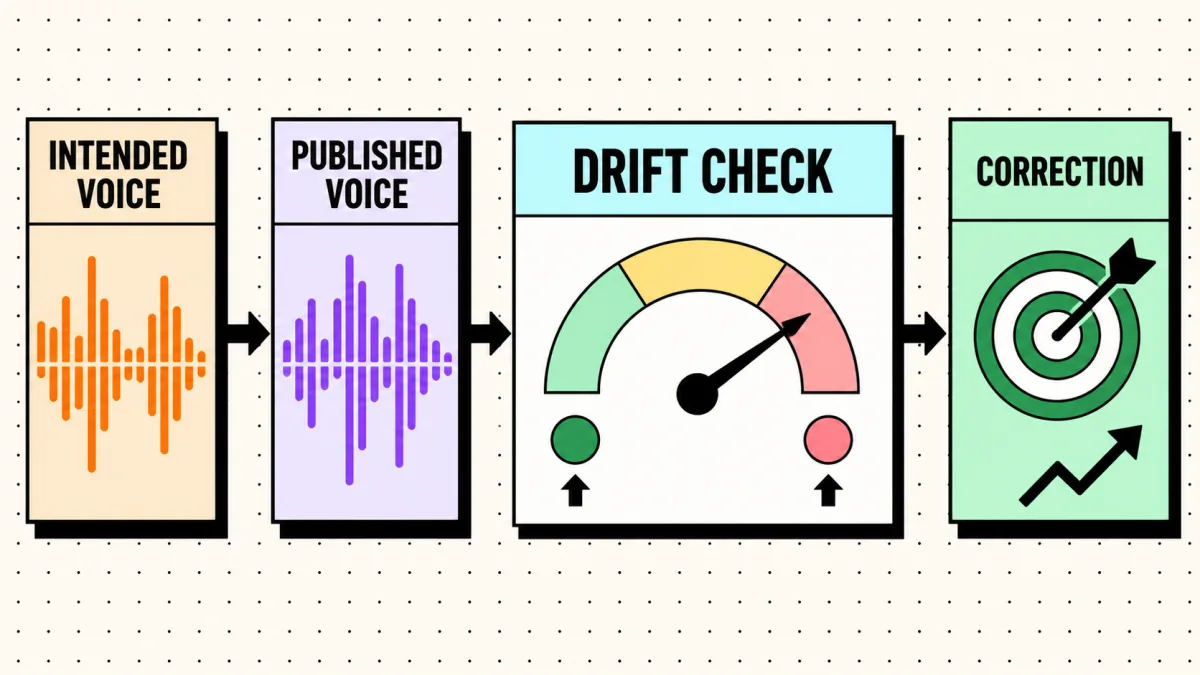
Even a well-configured AI system will drift without a feedback mechanism. Voice calibration is not a one-time setup task. It is an ongoing editorial process.

Practitioners in this space report that the most effective feedback loops have two components: a structured review process and a documented correction log. The review process catches drift in real time. The correction log turns individual corrections into systemic improvements.

In practice, this means:

  1. Reviewers flag posts that miss the voice mark and note specifically why (too formal, too casual, wrong register for this platform, uses a phrase we avoid).
  2. Those flags are aggregated monthly and used to update the brand voice documentation.
  3. Updated documentation is re-uploaded or re-configured in the AI platform.
  4. The cycle repeats.

This is how brand voice in AI writing improves over time rather than decaying. The system learns from real editorial decisions, not just the initial setup.

AI Voice Drift Checklist

Use this checklist during review or monthly audits:

  • Does the post use phrases any competitor could publish?
  • Does it mention a specific audience, workflow, market, or decision point?
  • Does it use approved brand vocabulary?
  • Does it avoid banned phrases, claims, and hype?
  • Does the platform format match how the audience reads there?
  • Would a human editor know why this post was approved?
  • Are reviewer edits being captured as reusable rules?

If the answer to the last question is no, the team is correcting content but not improving the system. That is how the same voice problems keep returning. For teams managing this at enterprise scale, the governance layer matters as much as the technical configuration. AI content governance for corporate marketing teams addresses how to structure oversight without creating bottlenecks.

A content strategy team maps AI voice calibration feedback on a whiteboard

Step 5: Audit Regularly for Voice Drift

A periodic voice audit is the most underused tool in corporate content operations. Most teams audit for performance metrics. Far fewer audit for voice consistency, which is a leading indicator of long-term brand equity erosion.

A practical voice audit does not require a large investment. Pull a sample of AI-generated posts from the last 90 days across each active channel. Read them as a sequence, not as individual posts. Ask: does this read like a coherent brand, or does it read like content from multiple different sources?

Specific signals to look for:

  • Inconsistent formality levels across posts on the same platform
  • Recurring phrases or constructions your brand would not use
  • Tone shifts that correlate with specific topics or content types
  • Posts that are technically accurate but feel off-brand in register

Audit findings feed directly back into Step 4. The correction log is only useful if it is populated with real observations from real content.

Connecting voice audit results to performance data also reveals something strategically important: whether on-brand content outperforms generic content in your specific channels. Many B2B teams find that the correlation is stronger than expected, particularly on LinkedIn where audience trust and familiarity compound over time. Measuring social media ROI for B2B marketing teams covers how to build that measurement framework.

Why This Matters More for B2B Social Teams

Generic AI content is more damaging in B2B because the audience is usually evaluating expertise, judgment, and fit. A bland post does not just underperform; it teaches buyers that the company thinks in generic language.

For corporate marketing teams, the goal is not to make every post sound handcrafted. The goal is to make automated content preserve the company's point of view, vocabulary, and standards at scale. That is where brand voice systems, approval workflows, platform variants, and scheduled publishing need to work together instead of living as separate tools.

FlyingToast is built for teams that want AI-generated social content to follow a real brand system, not a one-off prompt. Brand inputs, platform variants, approvals, scheduling, and feedback loops live in one workflow so social posts can move faster without becoming generic.

The Honest Trade-Off: Speed vs. Voice Fidelity

Fixing generic AI content requires upfront investment. Documenting brand voice at the level of specificity that actually changes AI output takes time. Building approval workflows and correction logs takes operational discipline. Running quarterly audits requires someone to own the process.

The trade-off is real: teams that skip this investment get faster content at lower voice fidelity. Teams that make the investment get content that scales without losing the thread.

For most corporate brands, the compounding advantage of consistent brand voice across dozens of channels over years is worth the setup cost. Generic content is not just a quality problem. It is a competitive positioning problem. If your AI-generated posts are indistinguishable from your competitors', you are producing volume without building differentiation.

The goal is not to make AI sound human. It is to make AI sound like your brand.

Key Takeaways

Generic AI content is a solvable problem, but the solution lives in the system, not the prompt. The core interventions are:

  • Convert brand voice documentation into structured, specific, machine-readable input
  • Configure voice at the platform level so every post inherits consistent parameters
  • Define per-platform voice variants that reflect how your brand registers differently across channels
  • Build a feedback loop that turns editorial corrections into ongoing system improvements
  • Run periodic voice audits to catch drift before it compounds

How to make AI content sound authentic is ultimately a question of how well you have documented and operationalized what authentic means for your brand. The AI can only work with what you give it, and the workflow determines whether that input gets reused or forgotten.

Share

ABOUT THE AUTHOR

Elise Hartmann
Elise Hartmann

Head of Content Strategy

FlyingToastBrand voice systems and editorial operations

Elise leads content strategy at FlyingToast, focused on how corporate brands keep a consistent voice across dozens of social channels. She writes about brand voice systems, B2B positioning, and building editorial processes that scale without losing the thread, leaning on frameworks and trade-offs over tactics of the week.

brand voicecontent strategyB2B positioningeditorial operations

Common questions

Frequently asked questions

Why does AI-generated content sound generic?+

AI-generated content sounds generic when the tool lacks specific brand context. Without audience details, positioning, approved vocabulary, banned phrases, proof points, and examples of good output, the model fills the gaps with safe, common language from its training patterns.

How do I make AI-generated social posts sound like my brand?+

Give the AI a structured brand voice system, not just a prompt. Document tone rules, approved examples, banned phrases, audience registers, platform variants, and review feedback. Then reuse those inputs across the content workflow so every generated post starts from the same brand standard.

What is an AI brand voice system?+

An AI brand voice system is a reusable set of inputs that tells an AI tool how a brand should write. It usually includes audience context, tone rules, approved vocabulary, banned phrases, example posts, platform-specific guidance, and reviewer feedback. Unlike a one-off prompt, it is reused across content workflows.

What causes AI tone of voice to drift over time?+

AI tone of voice drifts when prompts get simplified, context is not carried between sessions, reviewers change, platform variants are reused without adjustment, and edits are not captured as reusable rules. The fix is a feedback loop that turns recurring reviewer corrections into updated brand voice inputs.

TRY IT FREE

Ready to automate your social?

Upload your brand once. Get on-brand posts, automatically.

13+Platforms
14-dayFree trial
FastSetup flow
BrandVoice guardrails

Ready to put social media on autopilot?

Upload your brand data, connect your platforms, and let FlyingToast handle the rest. 14-day free trial, no credit card required.