 Justin van Oel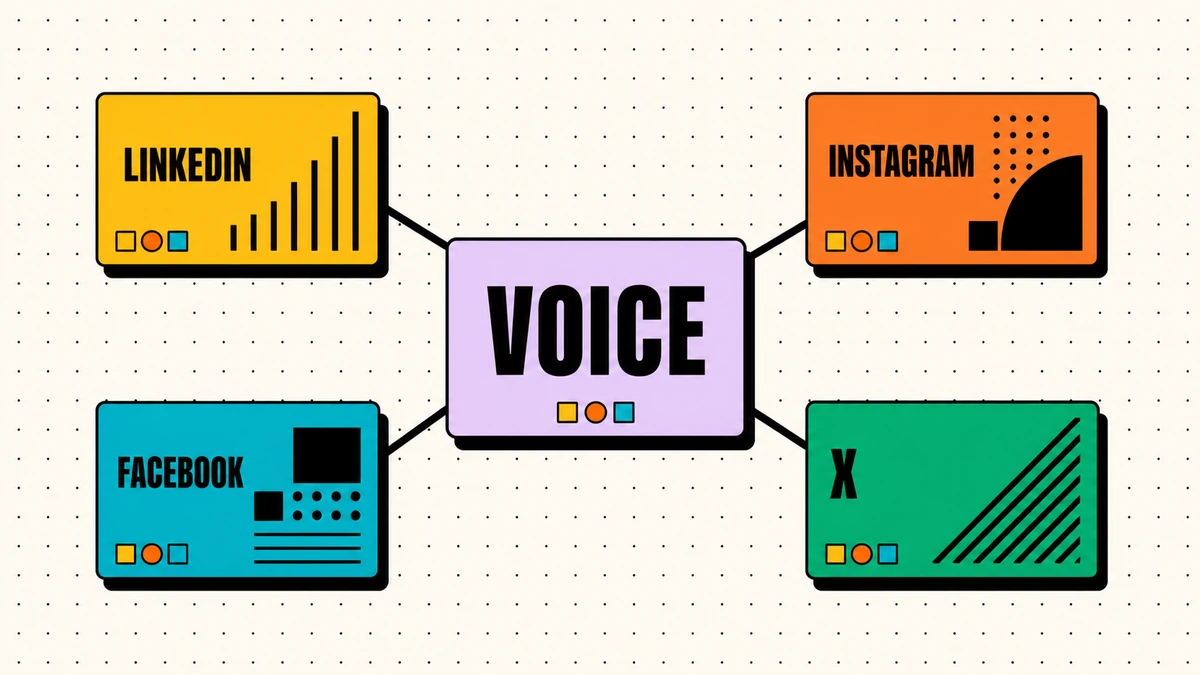
Most brands do not lose their voice in one dramatic moment. They lose it slowly, one rushed post at a time, until the LinkedIn account sounds like a press release and the Instagram account sounds like a different company entirely.
Brand voice consistency is not about sounding identical everywhere. It is about being recognizable while adapting the expression to the audience, format, and destination. This guide explains what voice is, how drift appears, and how to build a reviewable operating system around it.
What brand voice actually means
Brand voice is the consistent personality your audience hears across everything you publish. It is made of a few stable ingredients:
- Vocabulary: the words you reach for, and the ones you avoid.
- Tone range: how formal or warm you are, and how much that flexes by context.
- Point of view: the perspective and opinions your brand is willing to hold.
- Rhythm: sentence length, structure, and how you open and close.
When these stay stable, a reader can cover the logo and still know it is you. That recognition is the entire point.
Consistency is what turns a series of individual posts into a brand. Without it, you are just renting attention one post at a time.
Brand voice vs tone vs style
These three words get used interchangeably, which is part of why voice drifts. They are not the same thing, and keeping them straight makes a voice system far easier to apply.

Turn your brand context into social drafts
Turn your brand context into platform-aware social drafts for your connected channels. Start free, no credit card.
| Term | What it is | What changes | Example |
|---|---|---|---|
| Voice | The relatively stable personality behind what you publish | Deliberately, when the brand or positioning changes | Direct, warm, a little contrarian |
| Tone | How that voice flexes with context | By situation | Upbeat in a launch, measured in a support reply |
| Style | The mechanical rules | By channel or format | Sentence-case headlines, emoji policy, comma rules |
Voice is the thing you protect. Tone and style are allowed to move, as long as the voice underneath them stays recognizable.
Why voice drifts across channels
Drift is rarely a strategy decision. It is the sum of small pressures:
- Different people post on different channels, each bringing their own instincts.
- Each destination has different formats, audiences, and conventions, so the same idea may need a different register.
- Speed wins over review, and the easiest voice to write quickly is a generic one.
The fix is not to remove those pressures. It is to give everyone the same reference so their instincts converge instead of scatter.
The Voice Pillar model
A voice that lives only in someone's head cannot survive multiple writers and channels. The fix is to break voice into a small set of stable pillars that anyone can check their writing against. Four pillars are a useful starting example for describing what makes a brand recognizable:
| Pillar | What it defines | On-brand example | Off-brand tell |
|---|---|---|---|
| Vocabulary | The words you reach for and avoid | "Plain", "specific", "ship" | "Synergy", "leverage", "best-in-class" |
| Tone range | How warm or formal, and how much it flexes | Confident, not arrogant | Stiff and corporate, or try-hard casual |
| Point of view | The positions the brand will take | "Most dashboards measure the wrong things" | No opinion, only announcements |
| Rhythm | Sentence length and structure | Short. Then a longer line that explains it. | Every sentence the same padded length |
Documented this way, voice becomes less dependent on taste and easier for a contributor or reviewer to assess consistently.
Build a brand voice system
A voice system is a short, usable document plus a way to apply it. Start with a concise reference that contributors can use during real drafting and review; expand it only where additional detail resolves recurring ambiguity.
Define a small set of voice principles
Each principle pairs a trait with a guardrail, for example "Confident, not arrogant" or "Plain, not basic". Add one example of each in practice. Principles are easier to apply under pressure than a long style essay. A fictional B2B firm might land on three: "Specific, not vague", "Opinionated, not preachy", and "Plain, not basic", each with a one-line example of the principle in action. That is enough to settle most real writing decisions.
Adapt by channel without changing identity
Voice stays the same. Register adapts. A simple matrix keeps everyone aligned:
| Channel | Register | Length | Good for |
|---|---|---|---|
| Considered, professional | Medium to long | Points of view, lessons | |
| X | Direct, punchy | Short | Reactions, single ideas |
| Warm, visual-first | Short caption | Culture, behind the scenes | |
| Plain, accessible | Short to medium | Announcements, community | |
| Newsletter | Considered, personal | Long | Depth, narrative, owned audience |
The words and opinions stay yours. Only the delivery flexes.
A practical voice drift audit
You cannot manage drift you cannot see. Use a recurring sample review sized to your publishing volume and risk:
- Pull a recent cross-channel sample that represents the current publishing mix.
- Score each one against the four Voice Pillars: do the vocabulary, tone, point of view, and rhythm match?
- Flag the outliers and note what slipped. Usually it is a missing point of view or a register that drifted to fit the platform.
- Look for the pattern. Drift is rarely random; it clusters around a channel, a writer, or a content type under time pressure.
- Fix the reference, not just the post. If the same thing keeps slipping, the voice document is missing a rule.
A short recurring sample review can reveal drift before the same pattern spreads.
How voice survives when AI writes the first draft
More teams now generate the first draft with AI, which changes where drift comes from. An AI that has not been given your voice will produce competent, generic content that sounds like everyone else in your category. That is not an argument against using it. It is an argument for feeding it the same Voice Pillars you give human writers.
Tools that use reviewed brand context can apply the same guidance across more drafts, but teams should compare voice-fit scores, reviewer agreement, and substantive edit effort rather than assume consistency. Human review remains necessary where the content risk requires it. This is where voice consistency and AI content governance meet.
A short voice check
Before anything goes out, use a short review check:
- Does this sound like us, or like any company could have posted it?
- Are we using our words, not the industry's default phrases?
- Is the opinion clear, and is it one we would stand behind?
- Does the register fit the channel without changing who we are?
If you want the same checks applied during AI-assisted generation, define how drafts are scored and routed, then retain human review where required. The AI content governance guide explains that control layer, and the content calendar guide covers the operating rhythm.
Common brand voice mistakes
Common structural voice problems include:
- Generic vocabulary. Reaching for the industry's default phrases ("innovative", "scalable", "end-to-end") instead of your own words. It is the fastest way to sound like everyone else.
- No documented point of view. A brand that only announces, never argues, has no voice to be consistent about.
- Gatekeeper dependency. When one person holds the voice in their head, it leaves when they do, and it cannot scale.
- No channel register map. Without an agreed map of how voice flexes per channel, every writer guesses, and the guesses diverge.
Consistency becomes observable when reviewers can explain which rules a draft follows and trace recurring corrections back to the source, brief, or channel guidance.
Method note
The voice checks and examples in this guide are FlyingToast editorial methods. They should be tested against your own published corpus and audience rather than treated as revenue evidence.