 Justin van Oel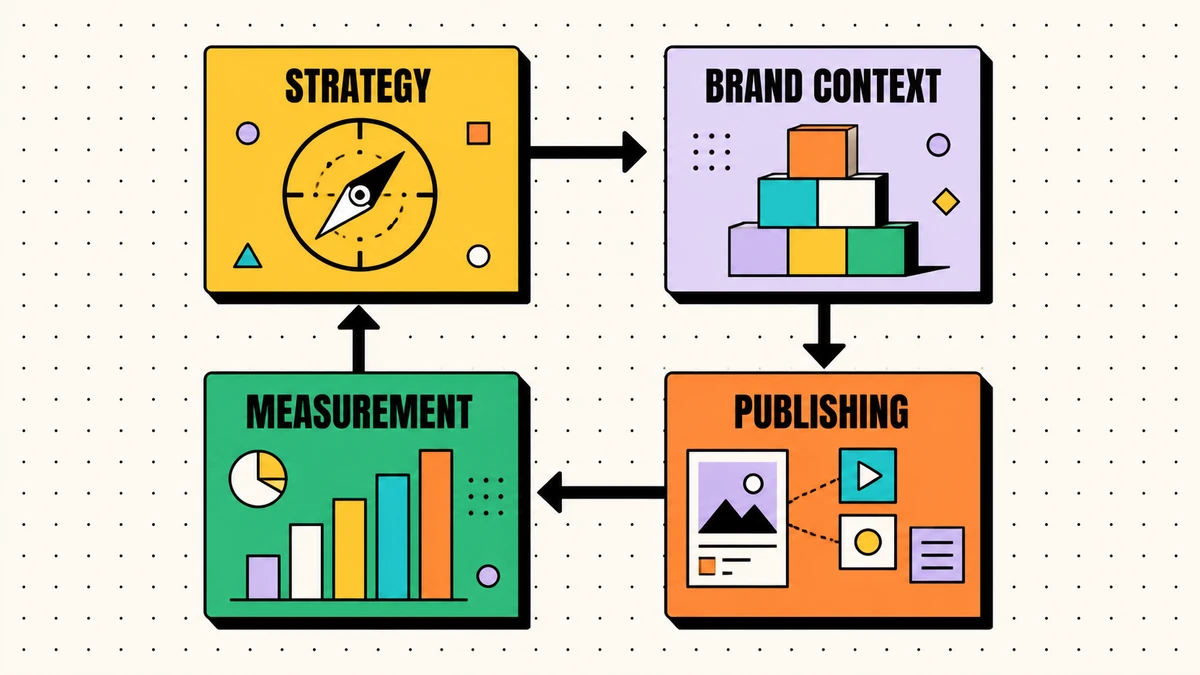
B2B social media marketing is the disciplined use of social channels to build brand authority, reach relevant buyers, and support measurable demand goals for companies selling to other businesses. Its contribution should be assessed with observed channel, audience, and commercial evidence rather than assumed from publishing activity alone.
Most corporate marketing teams already know this. The gap is execution at scale, and understanding how to build a system that holds together when you have multiple channels, multiple stakeholders, and a brand voice that cannot afford to drift. Our guide to keeping brand voice consistent across every social channel covers the underlying mechanics, but this article builds the strategic frame first.
Why most B2B social strategies stall before they scale
The most common failure mode is not a lack of content ideas. It is a lack of infrastructure to produce and publish consistently without quality decay.
Some B2B social programs become reactive when output, approval capacity, or ownership cannot sustain the planned cadence. The warning signs are missed slots, growing review queues, and a shift toward announcement-only publishing.
A common failure mode is building the strategy around individual effort rather than a repeatable process. One writer may carry the voice or one manager may hold the approval queue in their head. When that person is unavailable, the weakness in the operating model becomes visible.

Turn your brand context into social drafts
Turn your brand context into platform-aware social drafts for your connected channels. Start free, no credit card.
Sustainable B2B social requires treating content production as an editorial operation, not a creative sprint.
What makes B2B social different from B2C
B2B social media marketing operates on longer time horizons, smaller audiences, and higher-stakes content decisions than consumer marketing.
Gartner describes B2B buying as a nonlinear process in which buying-team members complete different tasks and use a mix of digital and human channels. That creates a practical content challenge: people in different roles may need different evidence and framing during the same evaluation.
This creates a specific content challenge: you need to address multiple personas without fragmenting your brand voice. The answer is not to write generically. It is to develop a clear point of view at the brand level, then express it in ways that are relevant to different audiences on different platforms.
Professional services firms face this acutely. A consulting firm, a law firm, or an accounting practice needs to project expertise and credibility simultaneously across LinkedIn, a company blog, and potentially YouTube or a podcast channel. Each medium has its own norms, but the underlying authority signal has to be consistent.
How to choose the right channels for B2B
Channel selection should follow audience concentration and content fit, not platform popularity or internal enthusiasm.
LinkedIn can be a useful starting point when the intended buyers and subject-matter experts are active there. It should still earn its place through audience evidence, content fit, and measurable contribution. A team whose buyers learn elsewhere should choose differently.
Beyond LinkedIn, evaluate each destination as a hypothesis rather than relying on a universal ranking. A useful pressure test asks:
| Decision question | Evidence to inspect |
|---|---|
| Is the intended audience active here? | Current customer interviews, source-of-lead data, and relevant public conversations |
| Does the destination support the format? | Current publishing constraints and the formats the team can produce well |
| Can the team operate it reliably? | Drafting, review, media, publishing, and response capacity |
| Does it contribute to the intended outcome? | Destination-level interaction, qualified visits, self-report, and CRM evidence |
YouTube may suit a team whose audience wants long-form explanation; X may suit a category whose intended practitioners are observably active there; a newsletter may suit a team that needs an owned long-form format. These are starting hypotheses to test, not stable market rules. A smaller channel set is often easier to operate and measure well than a broad, thinly supported presence.
Building a B2B content strategy that supports demand
A B2B content strategy can support demand by connecting brand-level expertise to specific buyer questions at each stage of the purchase journey.
Start with the questions your buyers are actually asking, not the messages your leadership team wants to broadcast. Sales calls, support tickets, and lost-deal analyses are richer sources of content intelligence than most editorial calendars reflect.
Structure your content output around three layers, a model you can think of as Authority, Relevance, and Conversion:
- Authority content establishes your point of view on the problems your category solves. This is evergreen, platform-agnostic, and the foundation of differentiated positioning.
- Relevance content connects your authority to current events, industry shifts, or seasonal business cycles. It signals that your perspective is live and informed, not static.
- Conversion-adjacent content addresses late-stage buyer questions: comparisons, implementation considerations, ROI frameworks. This content does not need to be salesy to be effective. It just needs to be specific.
| Layer | Its job | Example | Cadence |
|---|---|---|---|
| Authority | Establish your point of view | An original framework or contrarian take | Steady, evergreen |
| Relevance | Connect authority to now | A response to an industry shift | Reactive, timely |
| Conversion-adjacent | Answer late-stage questions | A comparison or ROI breakdown | As buyers near a decision |

Review whether the program over-indexes on reactive commentary and under-invests in durable expertise. A busy channel is not automatically a useful one.
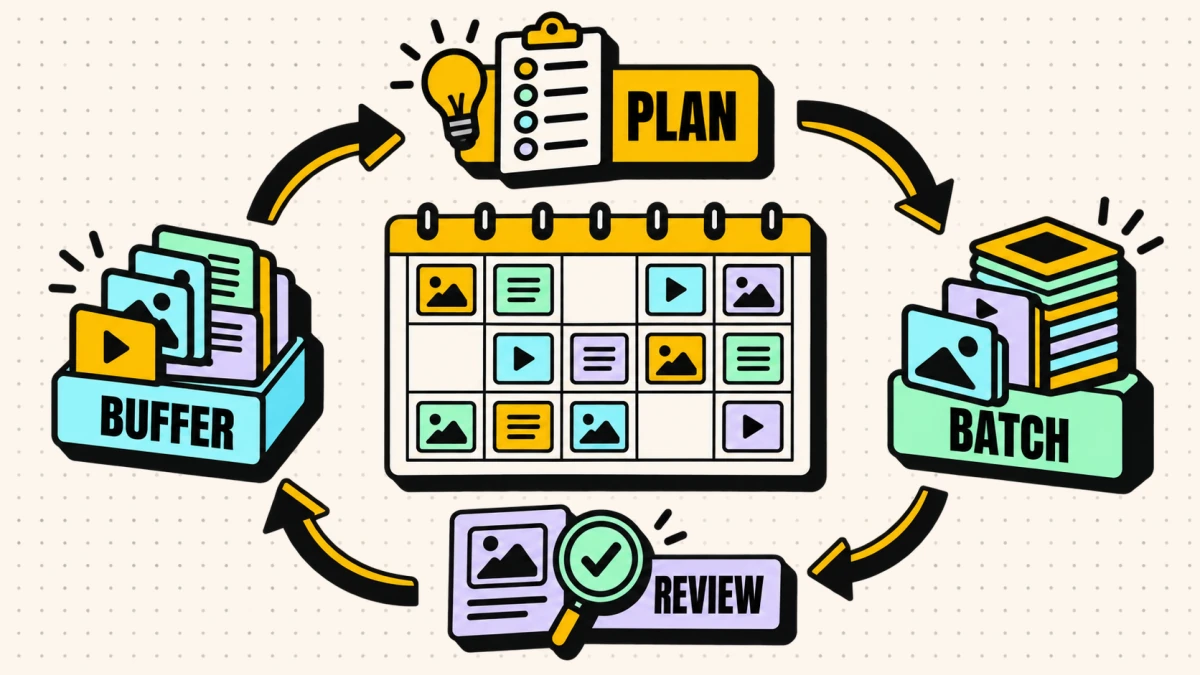
For the mechanics of sequencing and scheduling this output, the framework in our content calendar guide is a useful operational reference.
How brand voice becomes a competitive asset in B2B
In a crowded B2B category, a recognizable brand voice may help buyers distinguish one organization’s perspective from another.
Generic category language such as “innovative,” “scalable,” and “end-to-end” makes it harder to show what is specific about the organization. Review published content for interchangeable vocabulary, repeated sentence patterns, and claims that any competitor could make.
A distinct voice does not mean a quirky or informal one. For professional services and enterprise B2B, "distinct" often means more specific, more opinionated, and more willing to take a position. It means writing about your category the way only your firm would, because the perspective comes from genuine expertise and a defined worldview.
The operational challenge is maintaining that voice when content is produced by multiple writers, across multiple channels, at volume. A common pattern in enterprise content operations is that voice consistency holds at the center (flagship content, executive posts) and erodes at the edges (social captions, platform variants, regional accounts).
Documenting voice at the system level, not just in a style guide, is what separates teams that scale without drift from those that do not. This means capturing tone, vocabulary, sentence rhythm, and the specific positions your brand holds, in a format that can actually inform production decisions.
The role of automation in B2B social at scale
Automation creates strategic leverage in B2B social when it handles volume and consistency, freeing human judgment for strategy and creative direction.
The concern many marketing leaders raise about automation is valid: if you automate a weak voice, you produce weak content faster. The answer is not to avoid automation. It is to invest in voice documentation before deploying it.
AI-assisted content tools can use reviewed brand materials, existing content, and website sources as context for drafts. That can make brand rules easier to apply across a larger workflow, but it does not remove the need for source maintenance, human judgment, or destination-specific review.
The governance question matters here. Automation works best when it operates within a clearly defined approval structure: generated content reviewed before publishing for sensitive or high-stakes accounts, and autopilot reserved for channels where the risk profile is lower and the voice is well-established. Our piece on AI content governance for corporate marketing teams addresses how to structure those boundaries.
One genuine concern worth naming: over-automation without feedback loops produces content that is technically on-brand but strategically inert. Volume without signal is noise. Build in regular reviews of what is actually driving engagement and pipeline, not just what is being published.
How to measure B2B social media performance
B2B social measurement should connect channel activity to business outcomes, not just platform metrics.
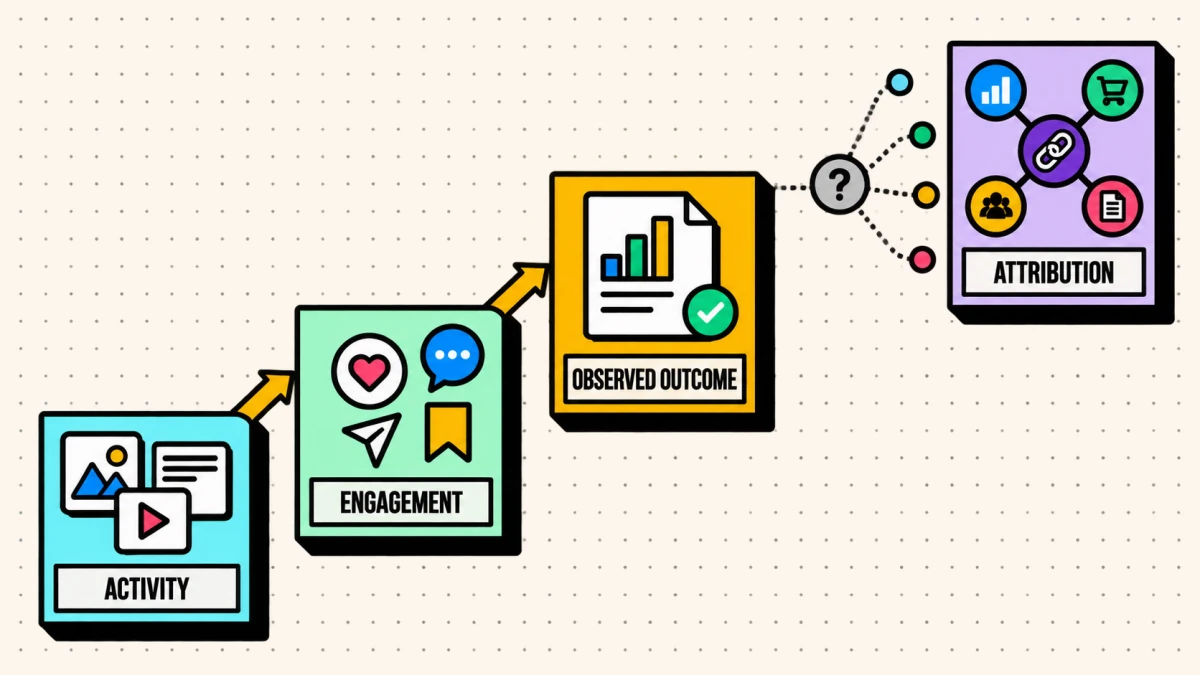
Vanity metrics (impressions, follower counts, likes) are not irrelevant, but they are not the story. The metrics that matter for B2B social connect to pipeline: content-influenced opportunities, engaged accounts in your target segments, and the role social touchpoints play in shortening time-to-close.
A practical measurement framework for B2B social operates at three levels:
- Channel health metrics: reach, engagement rate, posting consistency. These tell you whether the program is functioning.
- Audience quality metrics: follower composition, account-level engagement from target segments, inbound inquiries attributed to social content. These tell you whether you are reaching the right people.
- Pipeline contribution metrics: social-influenced pipeline, content assists on closed deals, demo requests from social traffic. These tell you whether the program is generating business value.
Assess separately which channel, audience, and commercial signals the team can currently observe. Connecting social analytics with CRM definitions can improve the evidence, but it does not create complete attribution. For a structured approach to this, our guide to measuring social media ROI for B2B marketing teams covers the integration logic in detail.
Common mistakes B2B teams make on social
The most costly B2B social mistakes are structural, not tactical. They compound over time and are harder to reverse than they appear.
Treating social as a broadcast channel. An announcement-only program omits the interaction side of social. Replies, relevant participation, and content that invites a useful response create additional observable signals; compare whether those interactions precede qualified conversations or pipeline in your own data.
Letting the approval process kill publishing cadence. A common pattern is that approval workflows designed for brand safety end up creating such friction that teams post infrequently to avoid the process. The fix is tiered governance: high scrutiny for sensitive content, streamlined review for routine posts, and clear criteria for each tier.
Assuming one content format works across platforms. A LinkedIn article, a short-form video script, and a short platform post have different constraints and jobs. Adapt the source message for each supported destination, then measure whether the variant improves comprehension, engagement, or the intended next step rather than assuming a performance lift.
Treating consistency as an outcome by itself. A dependable publishing rhythm creates a body of work that buyers can inspect, but frequency does not prove expertise or commercial impact. Review quality, audience fit, and downstream evidence alongside cadence.
Building a B2B social program that lasts
Social can be one of the digital surfaces buyers encounter during research, depending on the audience and category. A clear, sustained point of view gives those buyers material they can evaluate, but contribution to consideration or pipeline still needs evidence.
What makes it hard is the operational discipline required to sustain quality at volume, across channels, without losing the voice that makes the content worth reading.
The principles that hold across every B2B context: invest in voice documentation before scaling production, choose channels by audience concentration rather than novelty, build measurement that connects to pipeline rather than just platform metrics, and treat consistency as a strategic asset rather than a logistical burden.
The practical advantage goes to teams that can maintain useful content, review it responsibly, and learn from observable outcomes.
Sources
- Gartner, the B2B buying journey: B2B buying is nonlinear, involves different buying tasks, and uses a mix of digital and human channels.