 Justin van Oel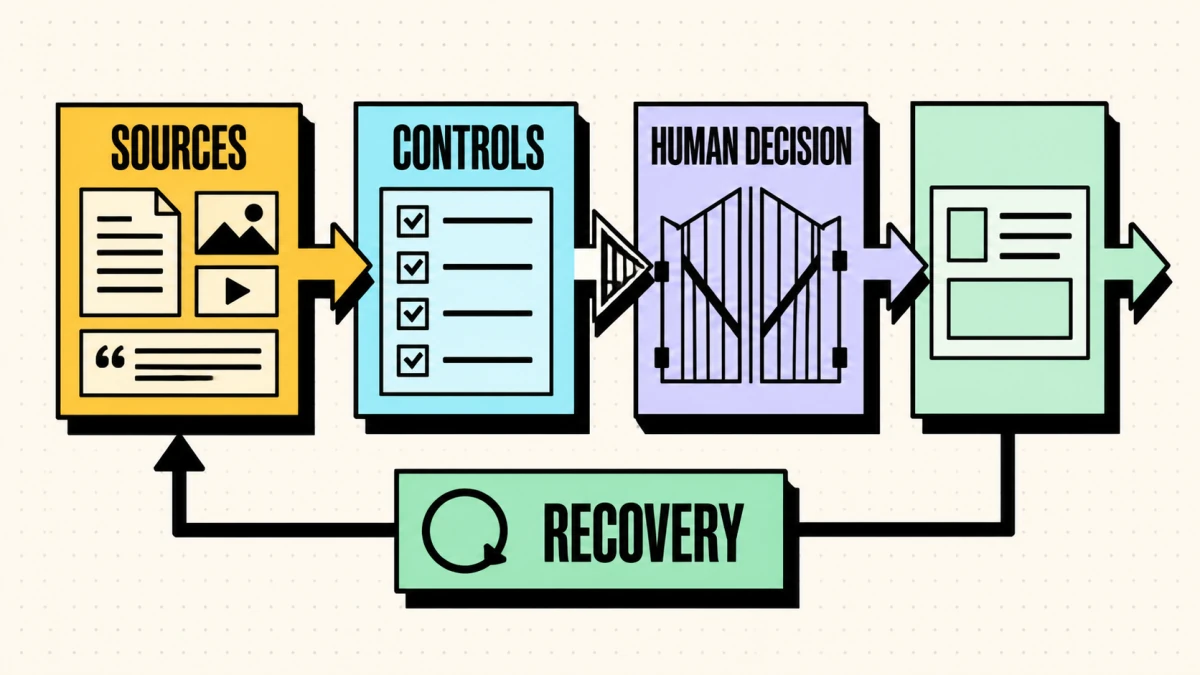
AI content governance is the operating system around AI-assisted marketing: who may use it, which sources it may rely on, what it must never invent, which checks happen before publishing, who accepts responsibility, and what happens when something goes wrong.
It is not a promise that errors cannot happen. It is a practical way to make risks visible, assign decisions to the right people, and preserve human accountability as content volume grows.
This guide presents FlyingToast's framework for marketing teams. It is operational guidance, not legal advice. Organizations working in regulated or high-impact contexts should have the relevant legal, compliance, privacy, security, or subject-matter owners review their own requirements.
Start with the outcome, not the AI tool
A useful governance process begins with a publishing decision:
What evidence and approval would we require if a person wrote this claim?
AI assistance should not lower that standard. The process may be faster, but the organization still owns the published result.

Turn your brand context into social drafts
Turn your brand context into platform-aware social drafts for your connected channels. Start free, no credit card.
The NIST AI Risk Management Framework organizes AI risk work around four functions: Govern, Map, Measure, and Manage. Its companion Generative AI Profile applies that thinking to generative systems. Marketing teams do not need to reproduce either document as a content checklist, but the underlying discipline is valuable: understand the context, identify material risks, measure what you can, and manage the remaining risk with named owners.
For day-to-day content operations, we translate that into three layers:
- Managed inputs: use current, approved source material and make uncertainty visible.
- Proportionate controls: combine generation constraints, automated checks, and human review according to the consequence of an error.
- Accountable decisions: record who approved publication and define correction and recovery paths.
Map content risk before designing the workflow
Not every post needs the same process. A useful risk map considers both the content and the consequence of being wrong.
| Content type | Example | Questions to ask | Possible owner |
|---|---|---|---|
| Routine editorial | Educational tip or event recap | Is it accurate, current, and on-brand? | Content owner |
| Product or commercial | Feature, price, comparison, outcome claim | Can the claim be verified against current product evidence? | Product marketing or product owner |
| Reputation-sensitive | Executive statement, incident response, public position | Who owns the organizational consequence? | Communications or leadership |
| High-impact or regulated | Health, finance, legal, privacy, safety, or jurisdiction-specific claim | Which rule, jurisdiction, reviewer, and recordkeeping duty apply? | Qualified internal or external reviewer |
This table is illustrative. Each organization should define its own categories, owners, and escalation rules. Avoid treating an industry label as a shortcut: the applicable requirement can depend on the entity, audience, jurisdiction, content, and channel.
Govern the sources before governing the output
An approval queue cannot repair weak source material at scale. Start by deciding which inputs are allowed and how they stay current.
For each source, record:
- who owns it;
- where it came from;
- when it was last reviewed;
- what it may be used to support;
- whether it contains sensitive or restricted information;
- when it should be reviewed again.
In FlyingToast, supplied documents, selected website content, and pasted text can become reviewable Brand Knowledge. That is source context used during generation; it is not customer-specific model training. A person can review and correct the resulting knowledge before relying on it for drafts.
Useful input controls include:
- an approved product-facts source for features, pricing, quotas, and availability;
- brand voice rules with examples and counterexamples;
- an organization-defined restricted-claims list;
- explicit jurisdiction or audience boundaries where they matter;
- a rule that statistics, regulations, prices, competitor facts, and customer outcomes require a current supporting source.
If evidence is absent, narrow or omit the claim. Fluent wording is not evidence.
Separate brand guidelines from an AI-use policy
Brand guidelines and an AI-use policy solve different problems.
| Document | Primary question | Typical contents |
|---|---|---|
| Brand guidelines | How should we communicate? | Voice, vocabulary, visual identity, audience, examples, prohibited phrasing |
| AI-use policy | Under what conditions may AI assist? | Approved tools, data boundaries, source requirements, review ownership, disclosure, escalation, recordkeeping |
The two should connect through operational controls. For example, “be precise” is a brand principle; “do not publish an exact product limit unless the approved product source supports it” is a testable control.
Review these documents when the product, risk profile, source material, team, or applicable requirement changes. A fixed 14-day, 30-day, or quarterly schedule may be useful for one team and wasteful for another; the trigger should reflect the rate and consequence of change.
Use layered guardrails, not a single confidence score
No one control can guarantee that generated content is true, lawful, safe, and on-brand. Layered controls reduce different failure modes:
1. Input controls
- approved and current sources;
- restricted data and claim categories;
- audience and jurisdiction context;
- clear ownership and review dates.
2. Generation constraints
- require supplied evidence for externally verifiable claims;
- prohibit invented statistics, sources, URLs, customer stories, prices, or regulations;
- distinguish fact, interpretation, and illustrative example;
- ask the model to state material uncertainty instead of hiding it.
3. Automated preflight checks
Automated checks are useful for deterministic conditions such as missing destinations, disconnected channels, prohibited phrases, empty fields, link formats, or absent source links. They can flag a problem; they cannot determine that every claim is accurate or compliant.
4. Human review
The reviewer should understand the consequence they are accepting. A content editor may own voice and clarity. A product owner may verify a feature claim. A qualified specialist may be needed for a high-impact statement. The right reviewer depends on the content, not merely their access level.
5. Publishing and recovery
Record the publishing decision, monitor the result, and define how to pause, correct, or remove content. A useful incident record captures what happened, what changed, who owns the follow-up, and which source or control needs updating.
What FlyingToast currently supports
FlyingToast can support a governed marketing workflow through:
- reviewable Brand Knowledge built from supplied material;
- organization and voice context used to create social drafts;
- platform-aware variants for supported connected-channel workflows;
- automated preflight and operational state checks;
- on plans with approvals, an authorized team member can approve or reject a pending post, with the acting user and rejection reason recorded;
- publishing logs and recovery states;
- configurable Autopilot behavior and guardrails.
There are important boundaries:
- FlyingToast does not make a legal or regulatory determination for your organization.
- A source link does not prove that a claim is supported; an editor must verify relevance, authority, freshness, and scope.
- Current approval behavior is an authorized-team-member approve/reject flow on eligible plans, not a demonstrated assigned-owner or multi-stage compliance system.
- Publishing logs and rejection reasons are not an immutable, regulation-compliant archive or system of record.
- Connected-channel capabilities vary by destination and workflow.
Those boundaries belong in the governance design. A trustworthy product description is itself a governance control.
A practical governance checklist
Before enabling AI-assisted publishing, confirm that you can answer these questions:
- Which content categories may use AI assistance?
- Which sources are approved, current, and owned?
- Which claims require direct evidence?
- Which data must not enter the workflow?
- Which automated checks are deterministic, and which decisions require judgment?
- Who can approve routine, commercial, reputation-sensitive, and high-impact content?
- What must never publish without a named review?
- What evidence of the decision is retained, and where?
- How do you pause publishing when context is stale or a channel state changes?
- Who corrects an error and updates the source or control that allowed it?
Document the answers in plain language. Test the workflow with realistic failure cases, not only successful drafts.
Make governance observable
Governance improves when teams can see where work stops and why. Track operational signals such as:
- drafts rejected for unsupported or stale claims;
- recurring correction categories;
- time spent waiting for the appropriate owner;
- publishing attempts blocked by channel or media state;
- sources that repeatedly require manual correction;
- incidents and the controls changed afterward.
These measures describe the workflow. They do not prove legal compliance or business impact by themselves.
The durable principle
AI content governance is not a document placed beside the publishing process. It is the publishing process: controlled sources, proportionate checks, accountable decisions, and a recovery path.
If you are implementing this in FlyingToast, continue with the AI content approval workflow, then review how to give AI reliable brand context. Our editorial and corrections policy explains how FlyingToast applies the same principles to its own articles.