How to build a brand voice style guide people actually use
A practical framework for turning voice principles into rules, examples, channel guidance, and review decisions marketing teams actually use.
- Written by
- Justin van Oel
- Published
- Reading time
- 10 min
- Updated

In this article · 10 sections
A brand voice style guide works only when people use it
A brand voice style guide documents how an organization communicates: its tone range, vocabulary, sentence patterns, point of view, and channel adaptations. It becomes useful when contributors can apply it consistently as the team and content output scale.
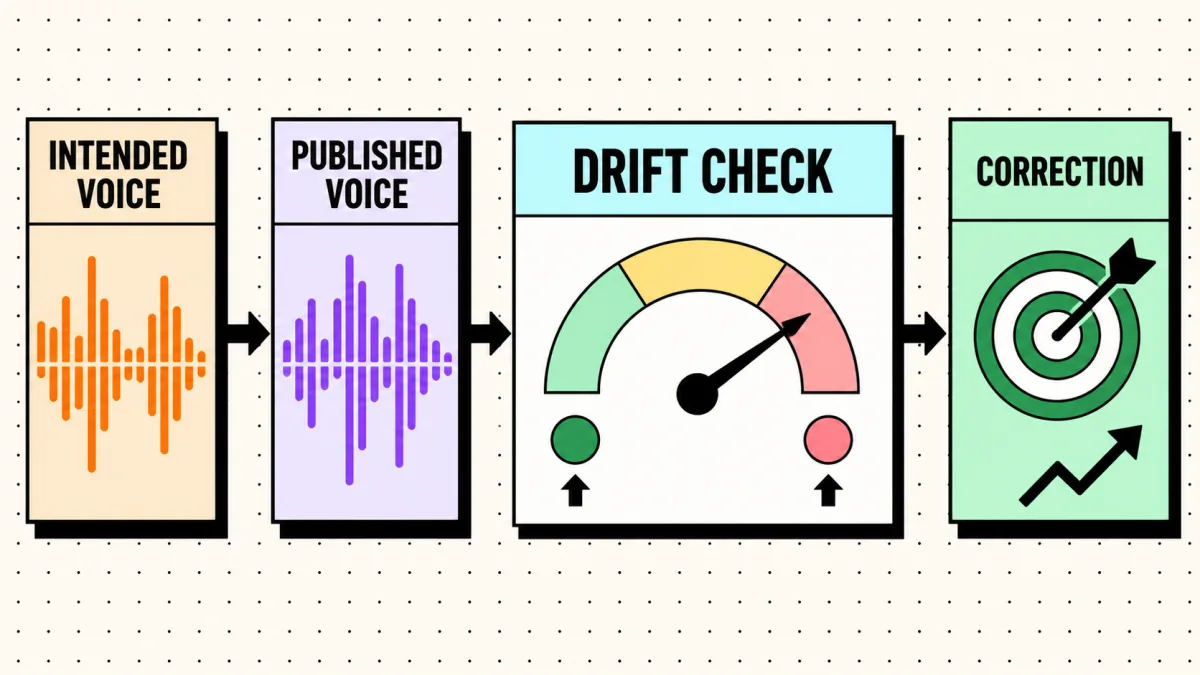
A brand voice guide is useful only when it changes real writing and review decisions. If it lives apart from briefs, examples, source context, and approval, contributors are left to interpret broad adjectives under deadline pressure. Our guide to keeping brand voice consistent across social channels shows how to connect the document to an operating process.
The question worth asking is not "do we have a brand voice style guide?" but "does ours change how people actually write?"
Why abstract brand voice documentation is hard to use
Abstract brand voice documentation is hard to apply because it describes an aspiration without showing writers what to do differently. Adjectives such as “bold,” “approachable,” and “expert” need observable rules, examples, and counterexamples before a reviewer can use them consistently.
The underlying problem is a category error. Many organizations treat the style guide as a brand artifact, something to approve and file, rather than as an operational tool for writers and content systems. When documentation is built for sign-off rather than daily use, it optimizes for comprehensiveness over usability.

Turn your brand context into social drafts
Turn your brand context into platform-aware social drafts for your connected channels. Start free, no credit card.
A common pattern in enterprise content operations is that the brand guidelines document runs to forty or sixty pages, covers logo clearance and color hex codes alongside voice principles, and requires navigating past brand history to find a single sentence on tone. Writers under deadline skip it entirely.
The fix is structural, not cosmetic. Voice documentation needs to be extracted from the broader brand guidelines and given its own format, one built around the decisions writers actually face.
What a brand voice style guide needs to contain
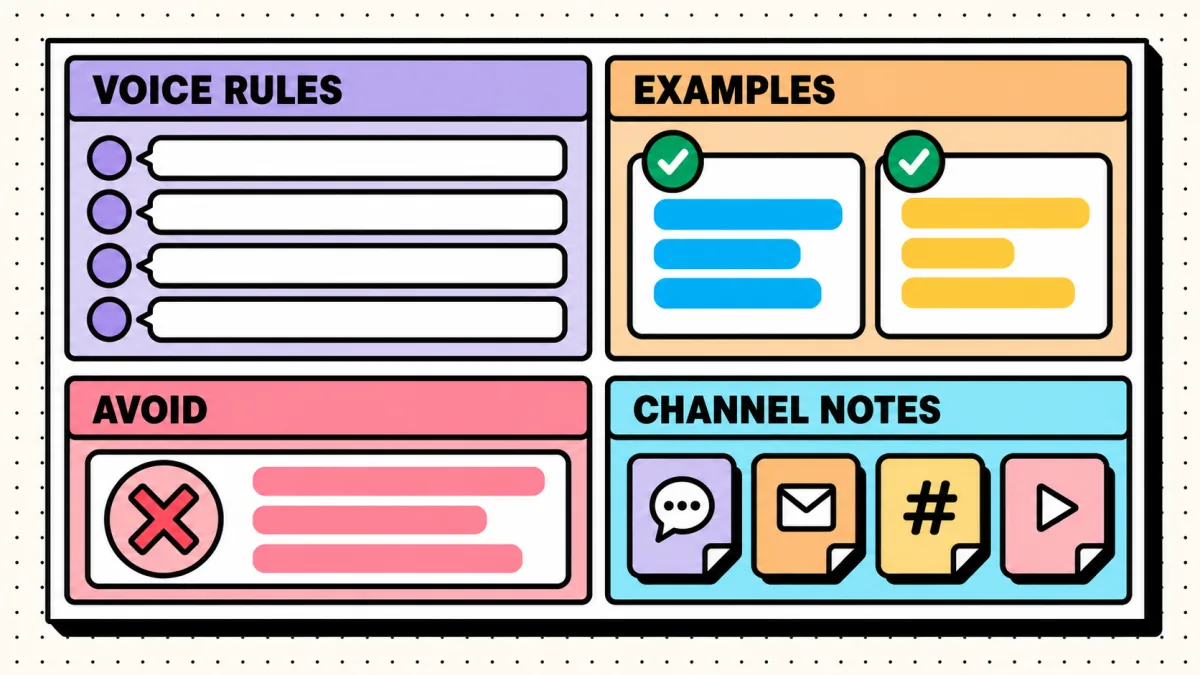
A practical starting structure includes core voice attributes, vocabulary guidance, writing rules, annotated examples, and destination-specific adaptations. Add sections only when they resolve a real writing or review decision.
Core voice attributes should be defined with behavioral specificity. Instead of "we are authoritative," write: "We state positions directly. We do not hedge with phrases like 'it could be argued' or 'some might say.' We back claims with observable evidence, not vague references to research." That is a directive a writer can act on.
Vocabulary guidance should include both preferred terms and explicit exclusions. Many B2B brands have category-specific language that signals expertise to their audience. They also have phrases that sound off-brand, jargon that belongs to competitors, or casual language that undercuts their positioning. List both sides.
Structural writing rules govern sentence length, paragraph rhythm, use of questions, and how the brand handles calls to action. These are the patterns that create a recognizable reading experience even when the topic changes.
Channel-specific adaptations acknowledge that LinkedIn and X require different registers without abandoning the core voice. A financial services firm can be precise and measured on LinkedIn while being sharper and more direct on X. The voice is the same; the expression shifts. The multi-platform publishing guide explains how to adapt a supported source message without silently changing its claim.
How to create brand voice guidance that reflects reality
Creating effective brand voice guidelines starts with auditing what your brand already sounds like at its best, not with writing down what you wish it sounded like. The gap between aspired voice and actual voice is where most style guides lose credibility with writers.
Step 1: Pull your best-performing content. Gather a representative sample of content that the team agrees reflects the brand well. Size the sample to the range of destinations, formats, and contributors you need to assess. Include social posts, long-form articles, email subject lines, and any copy that received strong internal or external response. This is your voice corpus.
Step 2: Identify recurring patterns. Look for sentence structure tendencies, vocabulary clusters, and tonal markers. Do your best posts lead with a strong declarative statement? Do they use second-person address consistently? Do they avoid passive voice? Document what you find, not what you intended.
Step 3: Identify what the brand never does. Negative space is as important as positive definition. If your brand never uses exclamation points, write that down. If you never open with a rhetorical question, note it. If competitor-adjacent buzzwords appear in drafts and get edited out, list them explicitly.
Step 4: Write the guidance as decisions, not descriptions. For each voice principle, ask: "What would a writer do differently because of this rule?" If the answer is nothing, the principle is not operational. Rewrite it until it changes behavior.
Step 5: Validate with the people who will use it. Before publishing, give the draft to the people who will use it and ask them to apply it to a real content brief. Where they hesitate or interpret rules differently, the documentation needs more specificity. Skipping this validation leaves conflicting interpretations unresolved before launch.

How to structure social media voice guidance
Social media requires its own section in any brand voice documentation because the constraints are categorically different from long-form content. Character limits, platform culture, and the speed of production all create pressure that generic guidelines cannot address.
Start with a platform-by-platform register map. For each platform your brand uses, define the acceptable range of tone: how formal, how direct, how conversational. A professional services firm might allow more personality on Instagram than on LinkedIn, but both need guardrails that connect back to the core voice.
Include post-level examples for each platform. Show an on-guideline post and an off-guideline post for the same topic, side by side. Explain what makes the difference. This format gives writers a reference they can pattern-match against under production pressure.
Address hashtag and emoji policy explicitly. Many brand guidelines treat these as afterthoughts. At higher publishing volume, ambiguous hashtag or emoji guidance can produce repeated inconsistencies. A clear rule, even a simple one, is more useful than silence.
Define how the brand handles trending topics and reactive content. This is where voice drift accelerates fastest, because reactive posts get written quickly and reviewed lightly. A brief decision framework, even three or four criteria, reduces the risk that opportunistic content undercuts brand positioning.
Make the guide part of daily work
A brand voice style guide that lives in a document is only as useful as the last time someone opened it. The operational challenge is embedding voice guidance into the workflows where content actually gets created and reviewed.
A practical approach is to integrate explicit voice criteria into drafting and review rather than treating the guide as a separate reference. Reviewers can then explain which rule a draft follows and record recurring corrections.
AI-assisted generation needs usable source and voice context rather than a document that is never connected to the workflow. Structured guidance can make a draft easier to evaluate, but it does not guarantee voice fit. The guide to why AI-generated social posts sound generic provides a diagnostic method.
The AI content approval workflow guide shows how to make evidence, review, rejection, and recovery explicit.
How AI changes the role of voice documentation
AI-assisted generation can repeat the same source or instruction problem across multiple drafts before review catches it. That makes current, operational voice guidance and a correction loop important.
Structured source and voice context gives a generation system organization-specific inputs such as preferred vocabulary, examples, and tonal boundaries. Output also depends on the model, brief, source freshness, destination constraints, and review. Measure voice fit and substantive edit effort rather than assuming improvement.
Build usable guidance before increasing automation so editors can diagnose whether a weak draft came from the source, instruction, model behavior, destination adaptation, or review process.
The complete guide to B2B social media marketing places voice inside the wider operating strategy.
Keep voice documentation current without rebuilding it constantly
Brand voice documentation decays. Markets shift, product positioning evolves, and the language that resonated two years ago may now sound dated or off-strategy. The challenge is maintaining the guide without creating a perpetual revision project.
Build a lightweight review trigger into editorial operations. Review a sample when positioning, products, contributors, or recurring correction patterns change. The right cadence depends on how quickly the underlying context changes; assign an owner rather than relying on a universal quarterly schedule.
Maintain a changelog. When voice guidance changes, note what changed and why. Teams that inherit brand documentation without context often revert to older patterns because they do not understand why a rule exists. A brief rationale next to each significant revision makes the reason easier to understand and apply.
Separate evergreen voice principles from campaign-specific guidance. Core voice attributes, vocabulary rules, and structural principles should change rarely. Campaign tone, seasonal register adjustments, and reactive content guidelines can live in a separate, more frequently updated section. Conflating the two creates instability in the foundation.
The AI content governance guide places voice documentation inside the broader control system.

Make the style guide a starting point, not a last resort
The final shift required is cultural, not structural. A brand voice style guide becomes operationally useful when it is treated as the starting point for content creation rather than a compliance check at the end.
Embedding the guide into briefs, templates, source context, and review makes the rules easier to apply. Teams should still audit reviewer agreement, recurring corrections, and published output.
A recognizable voice may support differentiation, but its commercial effect should be measured rather than assumed. The immediate standard is whether the guidance helps people and systems produce reviewable, coherent drafts.
The comparison of Autopilot and smart scheduling provides a framework for choosing an appropriate review posture.
The social media content calendar guide shows how to connect the guidance to a recurring operating rhythm.
Key takeaways
A brand voice style guide only delivers strategic leverage when it is built for daily use, not for sign-off. The documentation needs behavioral specificity, not abstract adjectives. It needs channel-specific guidance that reflects how social media actually works. And it needs to be embedded in the workflows where content is created and reviewed, not stored separately from them.
For teams adopting AI-assisted generation, precise operational guidance is a high-leverage input, not a guarantee. Evaluate it through reviewer agreement, recurring corrections, and substantive edit effort.
To assess the guide, pull a representative recent sample and ask reviewers to score it independently against the same criteria. Disagreement and recurring corrections reveal where the documentation needs work. Keep that editorial assessment separate from the commercial-attribution method in the B2B social ROI guide.