How to give AI reliable brand context for social content
A five-stage method for turning current source material into reviewed brand context and platform-aware social drafts.
- Written by
- Justin van Oel
- Published
- Reading time
- 6 min
- Updated

In this article · 15 sections
Giving AI reliable brand context means supplying current source material, turning it into reviewable facts and voice guidance, correcting what the system inferred, and using that approved context when creating a draft.
That is different from training a customer-specific model. In FlyingToast, your material is used as source context for generation; it does not become a bespoke fine-tuned model simply because you uploaded a document or connected a website.
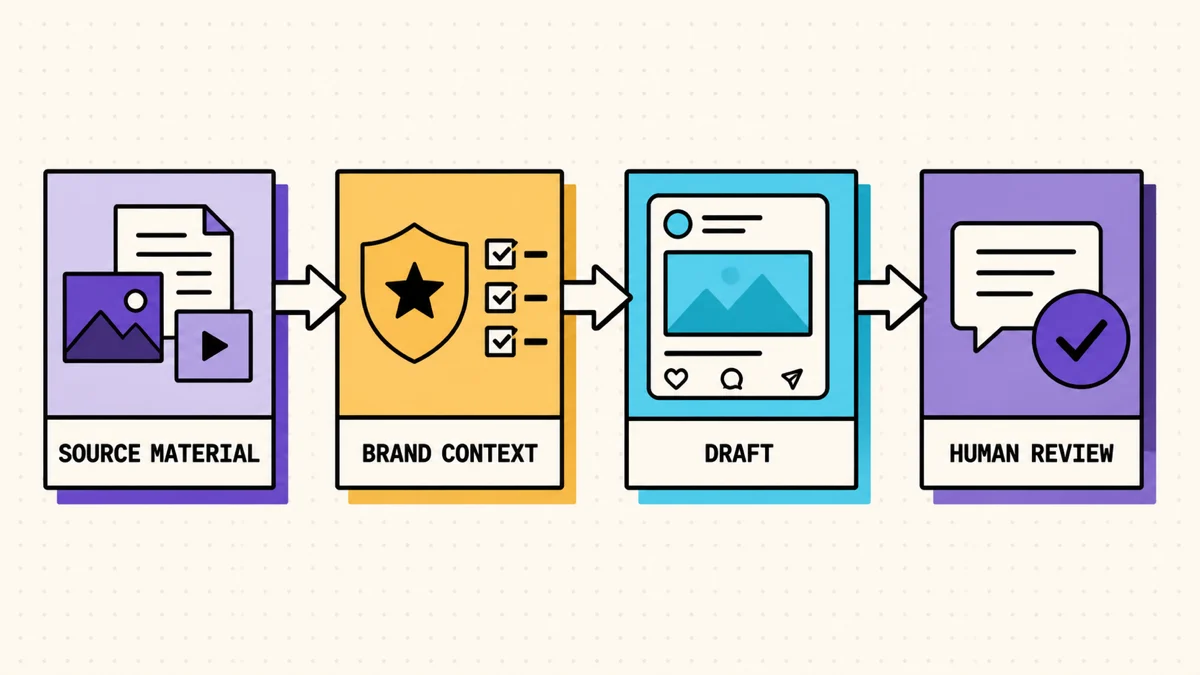
The five-stage workflow
The practical workflow is:
- Collect source material. Choose documents, website content, examples, and explicit rules that represent the brand now.
- Build reviewable Brand Knowledge. Extract useful facts, audience context, product details, vocabulary, and voice signals.
- Review and correct it. Remove stale material, narrow unsupported claims, and assign owners.
- Create a platform-aware draft. Use the approved context, brief, destination, and content objective together.
- Human review and feedback. Check factual support, voice, audience fit, and platform adaptation; feed corrections back into the source or rules.
The diagram on this page summarizes the path from source material to Brand Knowledge, draft, and human review.
Start with sources you are willing to defend
More material is not automatically better. A compact, current source set is more useful than a large archive of conflicting documents.

Turn your brand context into social drafts
Turn your brand context into platform-aware social drafts for your connected channels. Start free, no credit card.
Good candidates include:
- a current product or service fact sheet;
- your best recent writing samples, with an explanation of why they are representative;
- audience and positioning documents;
- a brand voice guide with examples and counterexamples;
- approved terminology and restricted claims;
- current pricing, availability, and feature information;
- campaign-specific evidence supplied for the brief.
Review sources before adding them. Remove outdated launch language, unsupported customer outcomes, superseded prices, and wording that belongs to one person but not the organization.
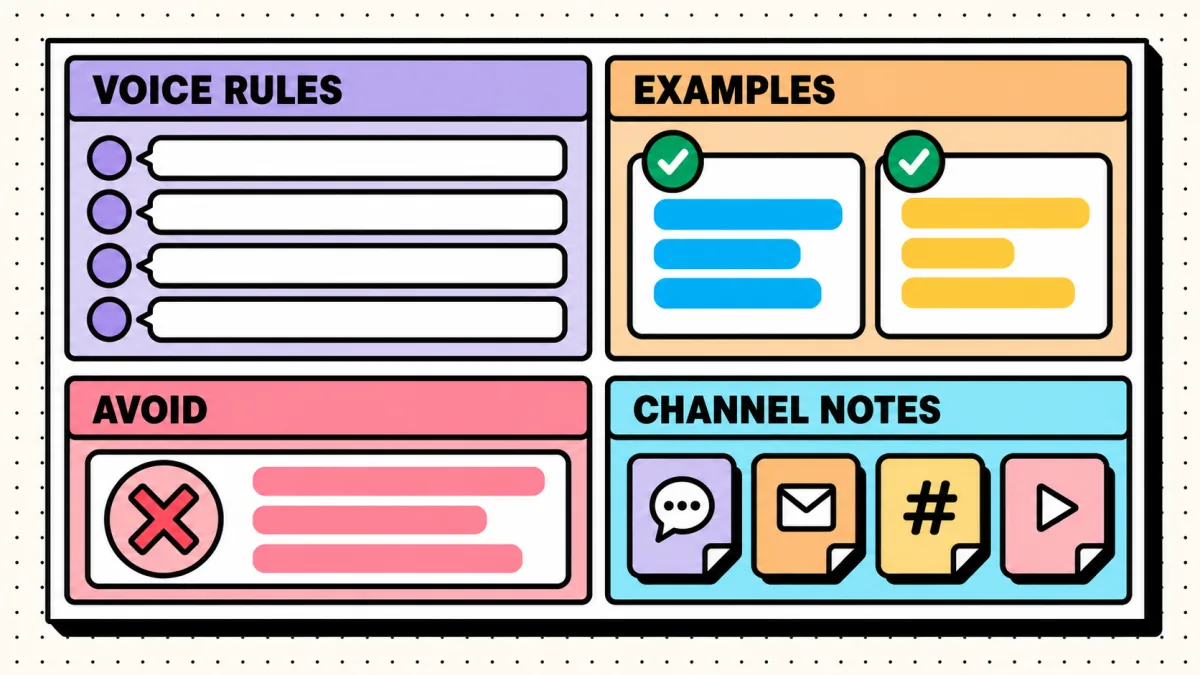
Separate facts, voice, and instructions
These three types of context have different jobs:
| Context type | Example | Review question |
|---|---|---|
| Fact | “Growth includes an allowance of up to 120 generated posts per month.” | Is this current and directly supported? |
| Voice | “Direct, practical, and willing to state limitations.” | Do our strongest examples consistently show this? |
| Instruction | “Do not invent customer results or competitor specifications.” | Is this explicit enough to test? |
Mixing them together makes correction harder. A factual correction should update the product source. A tone correction should update the voice guidance or examples. A repeated safety issue should update the generation or review instruction.
Make inferred knowledge reviewable
Source material is rarely perfectly structured. A system may infer an audience, value proposition, voice trait, or product relationship that the document only implies.
Treat those inferences as proposals. A person should be able to:
- see where an item came from;
- correct or reject it;
- identify uncertainty or conflict;
- assign an owner;
- review it when the underlying source changes.
This is why “we uploaded the website” is not a sufficient quality check. The website itself may contain old claims, mixed voices, or copy written for a different audience.
Use examples with annotations, not examples alone
An example tells the system what was written. An annotation explains why it represents the brand.
For each selected example, note:
- the intended audience;
- the communication objective;
- which voice traits are visible;
- words or structures that are characteristic;
- what should not be copied literally;
- whether the example still reflects the current product and position.
Counterexamples are useful too. “Do not sound corporate” is vague; an off-brand example with a short explanation is testable.
Add the brief and destination at generation time
Brand context is only one input. A useful draft also needs:
- a clear objective;
- the audience for this specific message;
- the claim or idea being communicated;
- current evidence;
- the connected-channel destination;
- format and timing constraints;
- the desired next action.
The same source message may need different structure on LinkedIn, Instagram, Facebook, or X. Platform-aware variation should preserve the claim and recognizable voice while adapting the opening, length, formatting, and call to action for the supported destination.
Review output against a rubric
“Sounds right” is hard to improve. Use a small rubric:
| Dimension | Review question |
|---|---|
| Claim support | Can every material factual statement be traced to a current source? |
| Specificity | Could this draft plausibly belong to any competitor? |
| Voice | Does it follow the approved vocabulary, stance, rhythm, and boundaries? |
| Audience | Does it address a real concern for the intended reader? |
| Platform fit | Is the structure suitable for this destination and workflow? |
| Edit effort | What did the reviewer need to change, and why? |
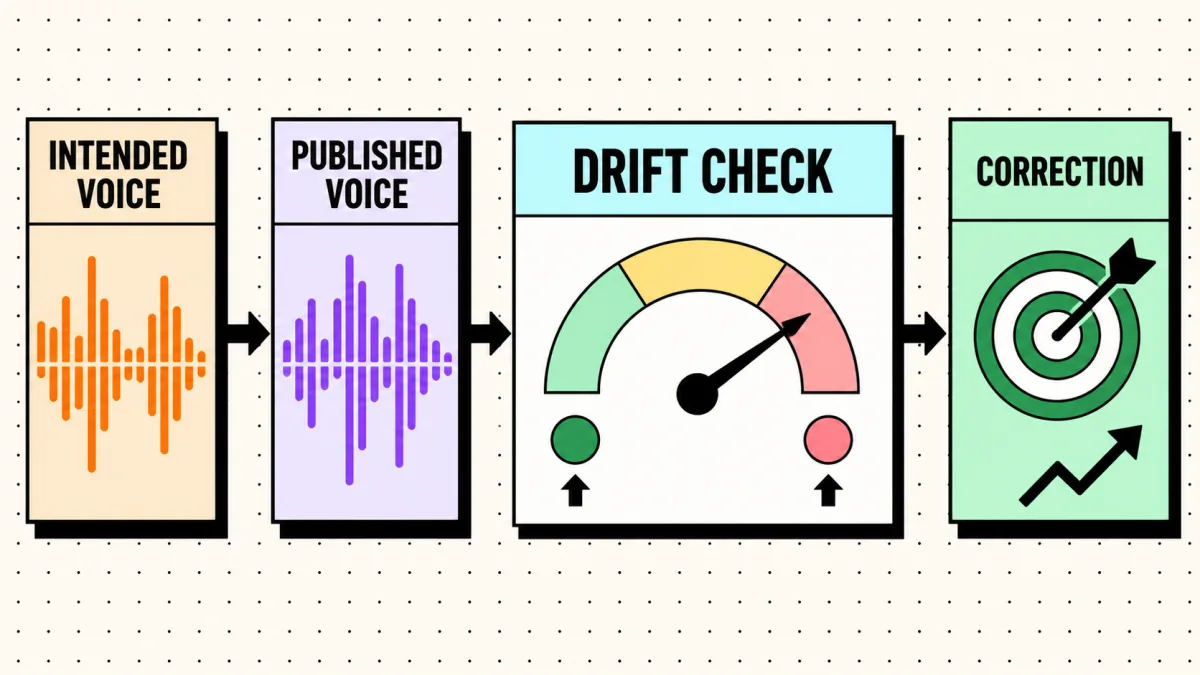
Record repeated corrections by category. If product facts are wrong, fix the product source. If drafts are vague, improve the brief and examples. If platform variants miss the mark, clarify the destination guidance. Do not keep correcting the same symptom only at the final copy stage.
Common failure modes
Stale source material
The draft confidently repeats an old price, quota, feature, or launch status. Assign owners to changeable sources and review them when the product changes.
Generic voice labels
Words such as “bold,” “approachable,” or “expert” are too broad on their own. Pair each trait with observable rules and examples.
Conflicting examples
If the example library mixes executive opinion, support replies, website copy, and old campaigns without labels, the resulting voice will be inconsistent. Curate by purpose and owner.
Unsupported claims in the source
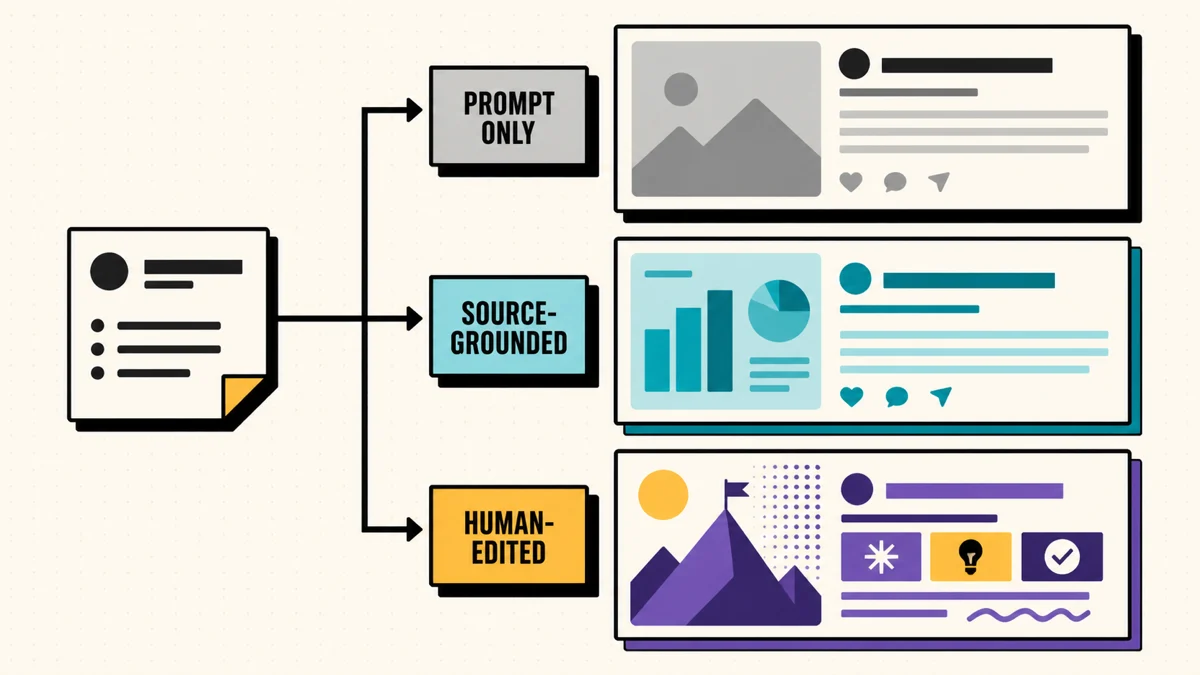
Source-grounded generation can still reproduce a claim that should never have been in the source. Grounding improves traceability; it does not turn weak evidence into strong evidence.
No correction loop
If reviewer edits never update the knowledge, rules, or brief, the same problems return. Categorize corrections and fix the upstream cause.
What FlyingToast does and does not do
FlyingToast can build reviewable Brand Knowledge from supplied documents, selected website content, and pasted text. It can use that context with voice settings and a brief to create platform-aware social drafts for supported connected-channel workflows.
It does not guarantee voice fidelity, factual accuracy, or legal compliance. It does not make every connected destination identical. A human remains responsible for reviewing material claims and deciding whether a draft should publish.
For the control system around sources and accountability, read AI content governance for marketing teams. For the publication decision, use the AI content approval workflow.
A practical setup checklist
- Choose a small, current source set.
- Separate facts, voice guidance, and instructions.
- Add examples and explain why they are representative.
- Identify restricted claims and evidence requirements.
- Review inferred Brand Knowledge before using it.
- Add audience, objective, evidence, and destination to each brief.
- Review drafts with a consistent rubric.
- Trace repeated corrections back to their upstream source.
- Re-review changeable context when the product or organization changes.
Reliable brand context is not a one-time upload. It is a maintained agreement between your sources, your reviewers, and the content you are willing to publish.