All articles

Building an AI Content Approval Workflow: A Step-by-Step Framework for Marketing Teams

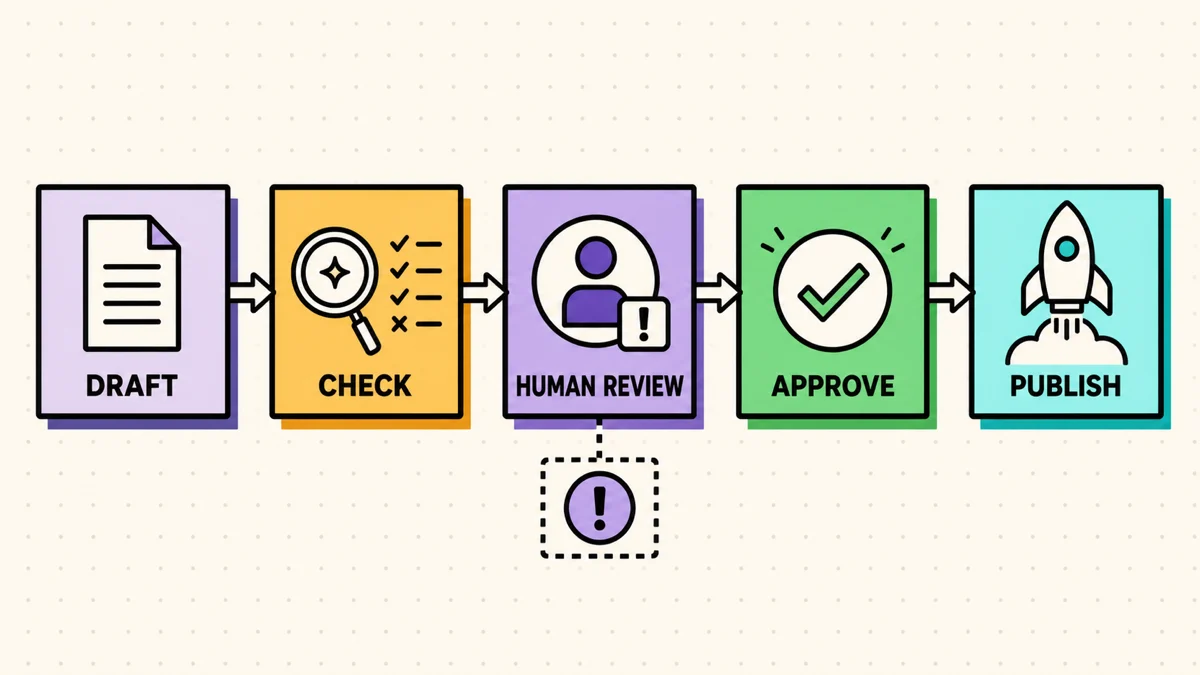
An AI content approval workflow is a structured sequence of review gates, role assignments, and publishing rules that governs how AI-generated content moves from draft to live post. Done well,

Marcus Bramwell Marcus Bramwell 14 min read
Share
Building an AI Content Approval Workflow: A Step-by-Step Framework for Marketing Teams

Why Most AI Content Approval Workflows Break Down Before They Scale

An AI content approval workflow is a structured sequence of review gates, role assignments, and publishing rules that governs how AI-generated content moves from draft to live post. Done well, it prevents brand-safety incidents, preserves voice consistency, and lets teams publish at volume without sacrificing accountability.

The problem is that most teams build their workflow reactively. They adopt an AI content tool, watch output volume jump, and then scramble to retrofit review processes that were designed for a human-written, one-post-at-a-time cadence. The result is either a bottleneck (every post stuck waiting for manual sign-off) or a gap (posts going live that nobody reviewed at all).

For context on how AI-generated content fits into a broader publishing operation, the complete guide to B2B social media marketing <a href="/blog/the-complete-guide-to-b2b-social-media-marketing">The complete guide to B2B social media marketing</a> covers the foundational decisions that shape what a governance layer needs to handle. This article focuses specifically on the approval workflow itself: how to design it, who belongs in it, and how to automate the right parts without losing control.

A marketing operations manager reviewing a queue of AI-generated social media drafts on a dual-monitor workstation, with a pr

What an AI Content Approval Workflow Actually Needs to Do

A functional AI content approval workflow must accomplish four things: catch brand-voice deviations before they publish, surface compliance risks for legal or regulated industries, maintain a clear audit trail of who approved what, and do all of this without creating a review queue so slow it defeats the purpose of automation.

Put your brand voice on autopilot

FlyingToast learns your brand voice and generates on-brand social posts across 13+ platforms. Start free, no credit card.

Start free trial →

Those four requirements sound straightforward. In practice, they pull in opposite directions. Speed and thoroughness are in tension. Centralised control and scalable volume are in tension. The workflow design is essentially a set of deliberate trade-offs between those competing pressures.

A common pattern in enterprise content operations is that teams underestimate how much the approval burden grows with output volume. When a team publishes five posts a week, a single reviewer can manage it. When AI tools push that to thirty posts a week across multiple platforms, the same single-reviewer model creates a permanent backlog. The workflow has to be designed for the volume you intend to reach, not the volume you have today.

Step One: Define What Requires Human Review (and What Doesn't)

Not every AI-generated post carries the same risk. The first structural decision in any AI content approval workflow is a content classification that separates posts by risk tier, because applying the same review intensity to every piece of content is what creates unsustainable queues.

A practical three-tier model works like this:

Tier 1: Standard posts. Evergreen educational content, product feature highlights, industry news shares. Low brand-safety risk, no regulatory exposure. These can move through a lightweight review or, once the AI is well-calibrated to brand voice, through an autopilot queue with periodic spot-checks.

Tier 2: Campaign and promotional posts. Anything tied to a specific offer, event, or campaign. These carry higher reputational stakes and should require at least one reviewer sign-off before publishing.

Tier 3: Sensitive or regulated content. Posts touching pricing, legal claims, healthcare guidance, financial advice, or any content category your industry regulates. These require a compliance review step, not just a marketing review.

The classification criteria should be documented, not held in someone's head. When the person who designed the system is out, the workflow should still function. For teams managing this across a content calendar, the approach to structuring a calendar that runs itself <a href="/blog/content-calendar-that-runs-itself">How to build a social media content calendar that runs itself</a> is directly relevant to how Tier 1 and Tier 2 content gets scheduled and surfaced.

Step Two: Assign Roles with Explicit Accountability

Approval workflows fail when accountability is diffuse. "The team reviews content" is not a role assignment. A functional workflow names a specific role at each gate, defines what that role is checking for, and sets a decision deadline.

The roles most corporate marketing teams need:

Content reviewer. Typically a marketing manager or senior content specialist. Checks for brand voice, tone, factual accuracy, and relevance. This role should not be responsible for legal or compliance judgments.

Brand approver. Often the brand or creative director. Approves Tier 2 content and any post that introduces new messaging, visual formats, or campaign language. This is a quality gate, not a bottleneck, so the role needs a defined SLA (24 hours is a common standard).

Compliance reviewer. Required for Tier 3 content. In professional services, financial services, or healthcare marketing, this role often sits outside the marketing team entirely. The workflow must route to this person before publishing, not after.

Publishing operator. The person or role with authority to move approved content to the live queue. Separating approval from publishing prevents a situation where an approver inadvertently triggers a live post.

Many B2B teams find that the biggest workflow failure is not a missing role but a missing deadline. Without explicit SLAs at each gate, content sits indefinitely and the queue backs up. Build the SLAs into the workflow documentation, not just into informal expectation.

Step Three: Build Your AI Content Checklist

An AI content checklist is the standardised set of criteria each reviewer applies at their gate. It removes subjectivity from the review process and makes it possible to onboard new reviewers without a lengthy apprenticeship period.

A content reviewer's checklist for AI-generated posts should cover:

  • Voice alignment. Does the post sound like the brand? Does it match the documented tone (formal, conversational, technical)?
  • Factual accuracy. Are any claims verifiable? Has the AI introduced any hallucinated statistics, product details, or attributions?
  • Platform fit. Is the post length and format appropriate for the target platform? A post calibrated for LinkedIn reads differently than one for X.
  • Visual consistency. If an AI-generated image accompanies the post, does it align with brand visual guidelines?
  • Link and CTA integrity. Are any URLs correct? Does the call to action match the campaign intent?

For Tier 3 content, the compliance checklist extends to jurisdiction-specific claim rules, required disclosures, and any industry-specific language restrictions.

The checklist should be a living document. When a post slips through with a problem, the post-mortem question is always: which checklist item was missing or unclear? Update the checklist, not just the process.

Brand voice consistency is one of the harder checklist items to operationalise, because it requires reviewers to have a calibrated sense of what "on-brand" means. The detailed framework in how to keep brand voice consistent across every social channel <a href="/blog/brand-voice-consistency-across-channels">How to keep brand voice consistent across every social channel</a> is useful reference material for building that shared standard.

Step Four: Configure Your Tooling to Enforce the Workflow

A workflow documented in a Google Doc and a workflow enforced by your tooling are not the same thing. The approval process needs to be built into the platform, not bolted on as a manual step.

Most AI content automation platforms support some form of approval queue, where generated posts are held for review before publishing. The critical configuration decisions are:

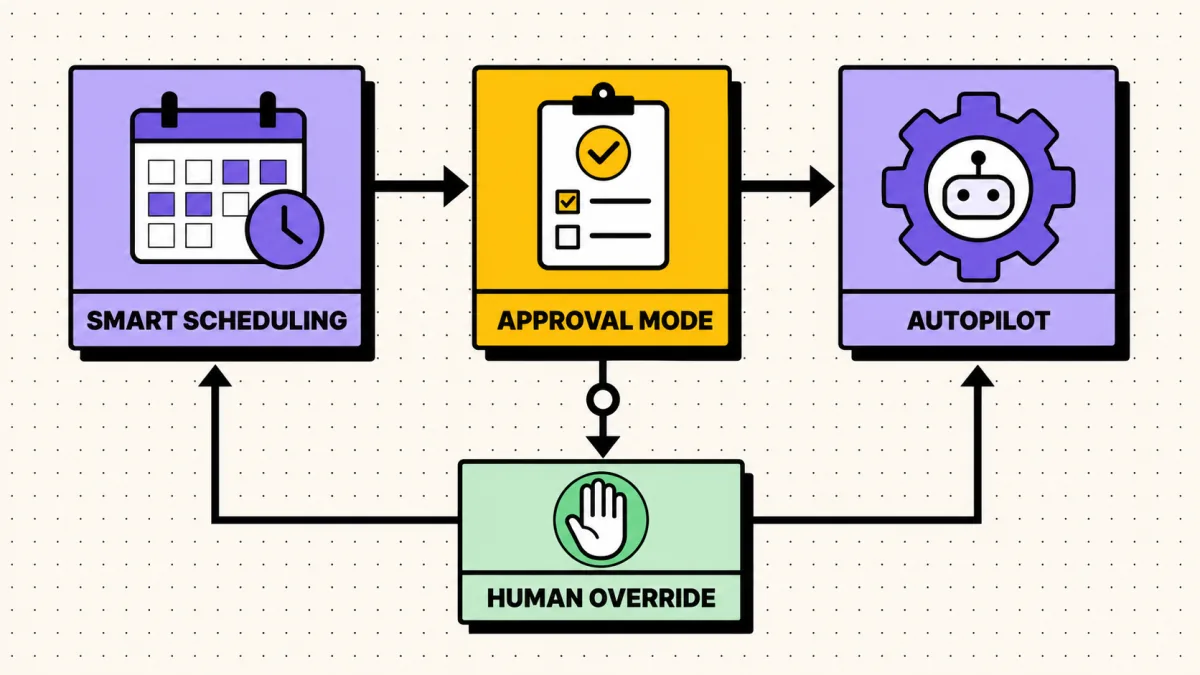
Approval queue vs. autopilot. An approval queue holds every post for human review. Autopilot publishes without review. Many teams use a hybrid: autopilot for Tier 1 content that meets certain criteria, approval queue for everything else. The criteria for routing between modes should be explicit, not left to default settings.

Role-based access. Only designated roles should be able to move content from the review queue to the live queue. If your platform allows any team member to approve and publish, that is a governance gap regardless of your documented policy.

Audit logging. Every approval action should be timestamped and attributed to a named user. This is not optional for regulated industries, and it is good practice for everyone else. When a post causes a problem, you need to know who approved it and when.

Notification routing. Reviewers should receive a notification when content enters their queue, not discover it by checking the platform manually. A workflow that depends on people remembering to check a dashboard will degrade over time.

For teams publishing across multiple platforms simultaneously, the multi-platform publishing guide <a href="/blog/multi-platform-publishing-without-copy-paste">One message, every platform: multi-platform publishing without the copy-paste</a> addresses how per-platform variants affect the review process, since a post approved for LinkedIn may need separate review for a version adapted to another platform.

A content approval workflow diagram displayed on a whiteboard in a marketing team meeting room, with sticky notes indicating

Step Five: Handle AI Image Review as a Separate Gate

AI-generated images introduce a distinct category of brand-safety risk that text-focused checklists miss. Visual content can carry unintended associations, misrepresent demographics, or produce outputs that are technically coherent but tonally wrong for the brand.

Many teams treat image review as an afterthought, bundling it into the text review step. That works at low volume. At scale, it creates a review step where the reviewer is simultaneously evaluating copy and imagery under time pressure, and one of those evaluations will get less attention.

A separate image review gate (even if it is the same person, completed as a distinct step) produces better outcomes. The checklist for image review should cover: visual alignment with brand guidelines, absence of unintended text or symbols in the generated image, demographic representation appropriate for the target audience, and consistency with the post's message.

It is worth noting that AI image generation does not always succeed. A practical workflow accounts for the scenario where image generation fails and the post needs to publish on a text-only basis, which may be acceptable for some platforms and not others. That decision should be documented in advance, not made ad hoc.

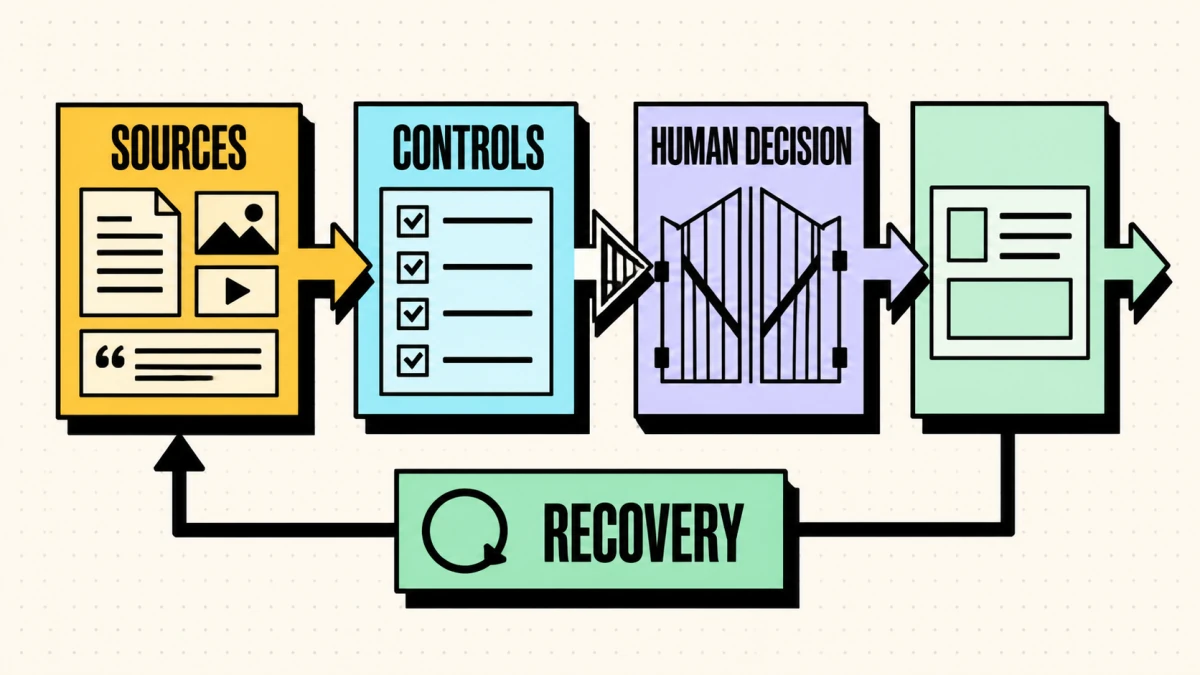
Step Six: Build a Feedback Loop Back into the AI

An approval workflow that only catches problems is a reactive system. A well-designed workflow also feeds information back into the AI to reduce the frequency of those problems over time.

Every time a reviewer edits an AI-generated post or rejects it, that is a data point about where the AI's output diverges from brand expectations. Teams that capture this systematically (through structured rejection reasons, edited-draft comparisons, or periodic voice-calibration reviews) see AI output quality improve over time. Teams that treat review as purely a gatekeeping function see the same errors recur.

The feedback mechanisms available depend on the platform. At minimum, teams should maintain a log of common AI errors by category (voice, factual accuracy, platform fit, imagery) and use that log to update the brand training inputs periodically. If the AI is learning from uploaded brand documents, updating those documents to address recurring gaps is a direct lever on output quality.

This connects to a broader point about AI content governance: the workflow is not just a safety net, it is a calibration mechanism. The governance framework overview in AI content governance for corporate marketing teams <a href="/blog/ai-content-governance-for-marketing-teams">AI content governance for corporate marketing teams</a> covers how this feedback loop fits into a longer-term governance strategy.

How to Measure Whether Your Approval Workflow Is Working

A workflow that produces no measurable outcomes is a policy document, not an operational system. Tracking a small set of workflow-specific metrics tells you whether the process is functioning or quietly degrading.

The metrics that matter most:

Review cycle time. How long does content spend in the approval queue on average? A rising cycle time signals either a bottleneck in reviewer capacity or a volume increase that the current staffing model cannot absorb.

Edit rate by content type. What percentage of AI-generated posts require edits before approval? A high edit rate on Tier 1 content suggests the AI's brand-voice calibration needs attention. A high edit rate on Tier 3 content may indicate the compliance checklist needs tightening.

Post-publish incident rate. How often does a published post generate a brand-safety concern, a compliance flag, or a public correction? This is the lagging indicator that tells you whether the upstream gates are working.

Approval queue abandonment. How often does content expire in the queue without being reviewed? Abandoned content is a sign that the workflow is creating more friction than the team can absorb.

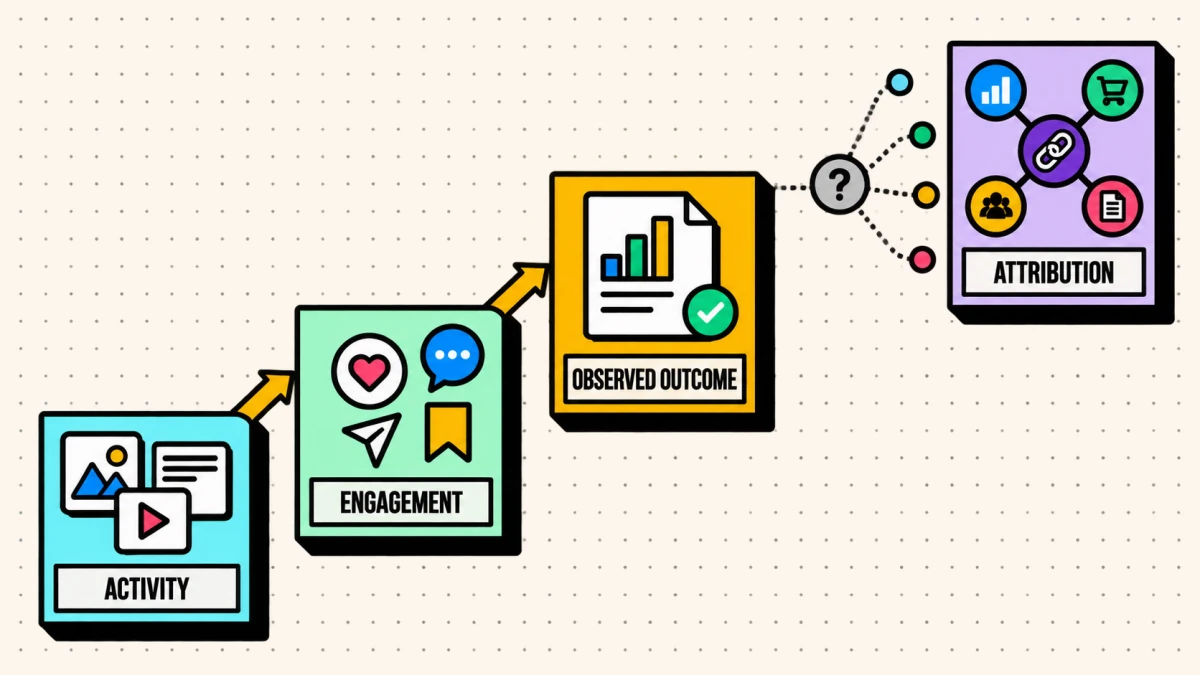
These metrics connect directly to the broader ROI question of whether automation is delivering its intended efficiency gains. The framework in measuring social media ROI for B2B marketing teams <a href="/blog/measuring-social-media-roi-b2b">Measuring social media ROI for B2B marketing teams</a> provides context for how workflow efficiency metrics fit into a full social ROI picture.

Governance Considerations for Regulated Industries

Professional services, financial services, healthcare, and legal marketing teams face a harder version of this problem. The approval workflow is not just a brand-quality mechanism; it is a compliance control. Failures carry regulatory consequences, not just reputational ones.

Several patterns are common in regulated-industry content operations. First, the compliance review gate is non-negotiable for any post making product, service, or outcome claims. Second, audit trails need to be exportable and retained for a defined period, because regulators may request them. Third, the approval workflow documentation itself may need to be part of a broader AI use policy that governance or legal teams have reviewed.

A practical approach for regulated teams is to treat the AI content workflow as an extension of existing content approval policies, not as a separate AI-specific process. If your firm already has a review process for marketing materials, map the AI workflow onto that structure first, then identify where AI-specific risks (hallucinated claims, image generation outputs) require additional gates.

Teams building out these policies will find the broader governance discussion in AI content governance for corporate marketing teams <a href="/blog/ai-content-governance-for-marketing-teams">AI content governance for corporate marketing teams</a> a useful reference for the policy-layer questions that sit above the workflow itself.

What "Good" Looks Like at Scale

A mature AI content approval workflow is not the most restrictive one. It is the one calibrated precisely to the actual risk profile of the content it processes.

High-performing teams at scale tend to share a few characteristics. They have documented tier classifications that route content to the right review path automatically. They have role-specific checklists that make review consistent regardless of who is doing it. They have tooling configured to enforce the workflow rather than relying on individual discipline. And they have a feedback mechanism that makes the AI's output incrementally better over time.

The goal is a system where the volume of AI-generated content can increase without a proportional increase in review burden, because the AI is better calibrated, the triage is more precise, and the reviewers are focused on the decisions that genuinely require human judgment.

That is not a destination most teams reach quickly. It is the result of iterative improvement on a workflow that was designed for scale from the start, rather than retrofitted after the fact.


Key takeaways:

  • Classify content by risk tier before assigning review intensity. Uniform review of all content is unsustainable at volume.
  • Assign named roles with explicit SLAs at each approval gate. Diffuse accountability produces backlogs.
  • Build and maintain a structured AI content checklist for each reviewer role. Subjectivity in review creates inconsistency.
  • Configure tooling to enforce the workflow, not just document it. Role-based access and audit logging are non-negotiable.
  • Treat image review as a distinct gate from text review.
  • Feed review outcomes back into AI calibration. A workflow that only catches problems without improving the source will fight the same battles indefinitely.
  • Measure review cycle time, edit rate, and post-publish incidents. A workflow without metrics cannot be improved.

How do you prevent the approval queue from becoming a publishing bottleneck?

Three interventions help most: accurate risk-tier classification (so low-risk content does not consume high-touch review capacity), explicit SLAs at each gate (so content does not sit indefinitely waiting for a decision), and periodic review of queue metrics to identify where delays are accumulating. If cycle time is rising, the cause is usually either a volume increase the current reviewer capacity cannot absorb or a tier-classification error routing too much content to the wrong gate.

Share

ABOUT THE AUTHOR

Marcus Bramwell
Marcus Bramwell

Marketing Operations Lead

FlyingToastSocial ROI, attribution, and AI content governance

Marcus runs marketing operations at FlyingToast and treats social the way an analyst treats a funnel: data, benchmarks, and a healthy skepticism of vanity metrics. He writes about social ROI, attribution, and the governance and compliance questions that surface when AI starts producing brand content at volume.

social ROIattributionmarketing operationsAI content governancecompliance

Common questions

Frequently asked questions

How do you decide which AI-generated posts need human review?+

Use a documented risk-tier classification. Low-risk evergreen content (Tier 1) can move through lightweight review or autopilot with spot-checks. Campaign and promotional posts (Tier 2) require at least one reviewer sign-off. Regulated or compliance-sensitive content (Tier 3) requires a full review sequence including a compliance gate. Classification criteria should be documented so the workflow functions consistently regardless of who is operating it.

Who should own the AI content approval workflow?+

Operational ownership typically sits with marketing operations or the senior content lead. However, the workflow must involve stakeholders from brand, compliance, and (for regulated industries) legal. The owner is responsible for maintaining workflow documentation, monitoring queue metrics, and managing the feedback loop back into AI calibration, not for making all review decisions personally.

How do you prevent the AI content approval queue from becoming a publishing bottleneck?+

Three interventions address most bottlenecks: accurate risk-tier classification so low-risk content does not consume high-touch review capacity; explicit SLAs at each review gate so content does not sit waiting indefinitely; and regular monitoring of cycle-time metrics to identify where delays are accumulating. Rising cycle time usually signals either a volume increase that current reviewer capacity cannot absorb or a classification error routing too much content to the wrong tier.

TRY IT FREE

Ready to automate your social?

Upload your brand once. Get on-brand posts, automatically.

13+Platforms
14-dayFree trial
FastSetup flow
BrandVoice guardrails

Ready to put social media on autopilot?

Upload your brand data, connect your platforms, and let FlyingToast handle the rest. 14-day free trial, no credit card required.