AI content approval workflow: a practical guide for marketing teams
A practical five-state approval workflow that makes evidence, responsibility, rejection, and recovery explicit.
- Written by
- Justin van Oel
- Published
- Reading time
- 10 min
- Updated

In this article · 15 sections
An AI content approval workflow should make five things clear: what is being checked, who owns the decision, what evidence they need, what happens when they reject a draft, and which conditions must stop publishing.
It should not promise that every mistake will be prevented. It should make responsibility and failure handling explicit.
This guide presents an operational pattern for marketing teams. It is not a compliance certification or legal opinion. Organizations should adapt the workflow to their content, jurisdictions, internal policies, and risk owners.
Use the copyable approval worksheet and worked example to put this workflow into practice.
The five-state workflow
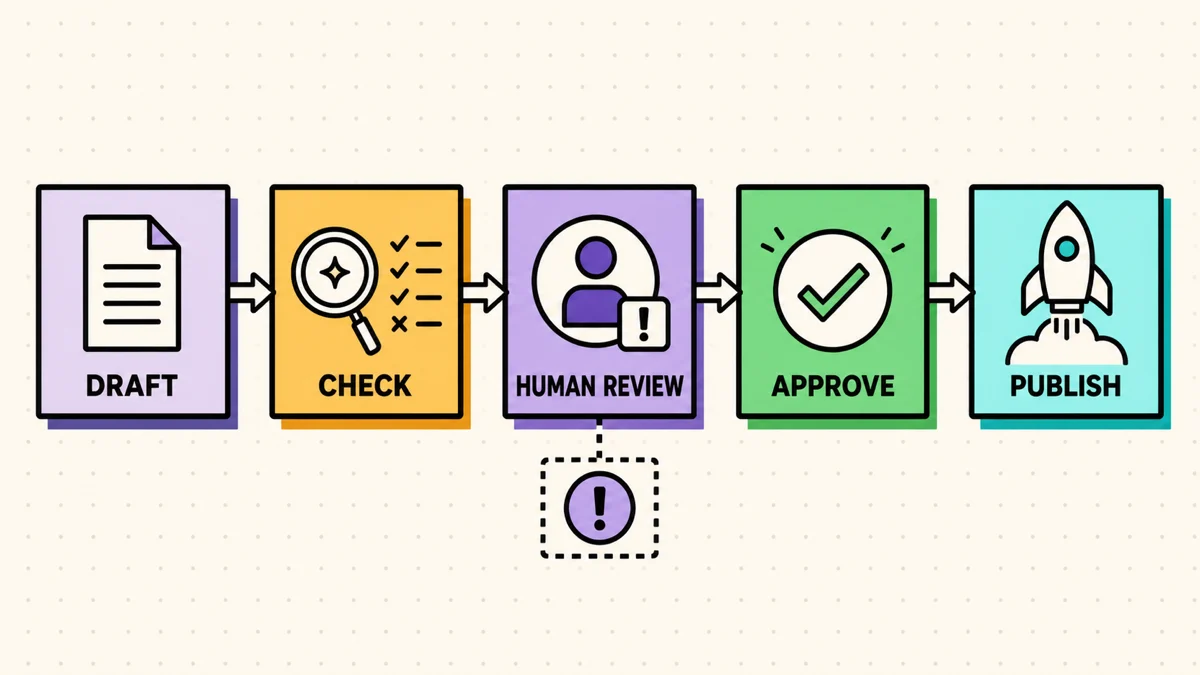
A practical workflow can be modeled as five states:

Turn your brand context into social drafts
Turn your brand context into platform-aware social drafts for your connected channels. Start free, no credit card.
- Draft: create a platform-aware draft from a defined brief and approved context.
- Check: run deterministic preflight checks and surface evidence gaps.
- Human review: give the accountable owner the draft, source context, destination, and known limitations.
- Approve or reject: record the decision and, for a rejection, the reason and required correction.
- Publish and monitor: publish only when operational checks pass, then retain enough information to investigate and correct an issue.
The diagram for this article shows that sequence deliberately: human review is a decision point, not a guarantee.
Step 1: define what requires review
Start with content categories rather than job titles. An illustrative model is:
| Content class | Example | Review question | Potential owner |
|---|---|---|---|
| Routine editorial | Educational post or event recap | Is it accurate, useful, current, and on-brand? | Content owner |
| Product or commercial | Feature, price, comparison, customer outcome | Does current evidence support every material claim? | Product marketing or product owner |
| Reputation-sensitive | Executive statement, incident response | Who accepts the organizational consequence? | Communications or leadership |
| High-impact | Health, finance, legal, privacy, security, or safety claim | Which qualified reviewer and recordkeeping process apply? | Appropriate specialist |
This is a starting point, not a universal rule. “Regulated” is not one content class, and a product mention does not automatically require the same process in every organization. Define your routing with the people responsible for the outcome.
Step 2: name one accountable owner for each decision
Access to a review screen is not the same as approval authority. For every content class, document:
- who prepares the draft;
- who verifies the claim and source;
- who may approve publication;
- who can pause or remove content;
- who resolves an escalation.
The useful principle is simple: the person or role that owns the consequence should hold the relevant decision authority.
A small team may combine roles. A larger team may split them. If several approvals are genuinely required, the workflow and product must support that sequence; do not describe a single approve/reject step as a multi-stage approval system.
Step 3: show the reviewer the right context
A review screen should help someone make a decision, not merely present polished copy. Where relevant, include:
- the destination account and platform variant;
- the original brief or objective;
- the source material used for factual claims;
- the current product facts for commercial content;
- the image and alt text;
- links, mentions, and required disclosures;
- automated flags and unresolved warnings;
- the scheduled time and timezone;
- prior rejection reasons or corrections.
Do not turn a green automated check into a claim that the content is true or compliant. A link-presence check, for example, only establishes that a link exists. A person still needs to assess whether it supports the claim.
Step 4: make rejection useful
“Needs work” creates another review cycle without teaching the system or the team anything. Use a small, consistent set of rejection reasons, such as:
- fact or source is wrong;
- claim is unsupported or too broad;
- product detail is stale;
- voice or audience fit is wrong;
- platform variant needs adjustment;
- image is inaccurate, unsuitable, or missing;
- disclosure or internal policy requirement is unresolved;
- wrong destination, timing, or campaign context.
Add a specific correction note. Over time, recurring reasons reveal whether the problem sits in the source material, brief, generation constraint, reviewer guidance, or product workflow.
Step 5: separate editorial evidence from regulatory records
Approval history is useful operational evidence. It may include a named user, timestamp, decision, rejection reason, draft version, and publishing result.
That does not automatically make the system a regulation-compliant archive or system of record. Some organizations may have separate supervision, retention, immutability, retrieval, privacy, or jurisdiction-specific duties. Scope those requirements with qualified owners and use an appropriate recordkeeping system where needed.
On plans with approvals, an authorized team member can approve or reject a pending post; FlyingToast records the acting user and a required rejection reason. The product also provides publishing logs and operational recovery states. It does not claim to provide assigned-owner routing, immutable regulatory archiving, or a universal multi-stage approval implementation.
Design preflight checks around deterministic facts
Good automated checks answer questions a system can reliably evaluate:
- Is the connected channel available?
- Is the destination authorized?
- Is required content present?
- Is the scheduled time valid?
- Did media processing succeed?
- Does the draft contain a prohibited phrase configured by the organization?
- Is an external source link present when the editorial policy requires one?
Human judgment is still needed for questions such as:
- Does the source actually support the claim?
- Is the wording fair and appropriately scoped?
- Is an endorsement disclosure clear and close enough to the endorsement?
- Could context make a technically true statement misleading?
- Is the post suitable for this audience and moment?
For endorsements and reviews, the FTC's Endorsement Guides guidance is a useful primary source for United States audiences. Other claims and jurisdictions require their own applicable sources and reviewers.
Choose service targets from actual risk
Review deadlines should be explicit, but avoid presenting one number as an industry standard. A team might choose a four-hour, one-day, or multi-day target depending on urgency, reviewer availability, and consequence.
Define:
- the target review time for each content class;
- what happens when the target is missed;
- whether the post is paused, reassigned, or rescheduled;
- which urgent content is allowed to use an expedited path;
- who reviews that expedited path afterward.
If nobody responds, the safe default for content that requires approval is to remain unpublished.
Test failure paths before launch
Run the workflow through realistic scenarios:
- the product price changed after the draft was created;
- a source link exists but does not support the sentence;
- the approver rejects the image but accepts the copy;
- a connected channel becomes unavailable before the scheduled time;
- media processing fails;
- the named reviewer is away;
- a published post needs a correction;
- the organization needs records beyond the publishing log.
The test is not complete when the happy path publishes. It is complete when every failure has a clear state, owner, and recovery action.
A lightweight RACI template
Use this as a starting worksheet and adapt it to your organization:
| Activity | Responsible | Accountable | Consulted | Informed |
|---|---|---|---|---|
| Maintain approved sources | Content or product owner | Marketing lead | Subject-matter owner | Contributors |
| Draft routine content | Creator or AI-assisted workflow | Content owner | Brand owner | Publisher |
| Verify product claims | Product marketing | Product owner | Support or legal where relevant | Content owner |
| Review high-impact claims | Assigned specialist | Risk owner | Legal, privacy, security, or compliance as applicable | Marketing lead |
| Approve publication | Named approver | Publishing owner | Relevant reviewer | Stakeholders |
| Correct or remove content | Publishing operator | Communications or risk owner | Original approver | Affected stakeholders |
The labels do not matter as much as having one unambiguous accountable owner.
What this looks like in FlyingToast
FlyingToast can use reviewed Brand Knowledge and voice context to create platform-aware drafts for supported connected-channel workflows. A team can route content to an owner for approval or rejection, capture a rejection reason, and use operational checks before publishing.
Autopilot is a configured posture, not a promise that every eligible draft will publish unattended. Missing context, failed media, disconnected channels, authorization state, and other safeguards can stop the workflow.
For the wider control system around sources, policies, monitoring, and recovery, read AI content governance for marketing teams. To improve the inputs that reviewers see, continue with how to give AI reliable brand context.
Copyable AI content approval worksheet
Use one review record per post and platform variant. Copy the fields below into your team's document or task system, then name the people who will use them. This is an example editorial worksheet, not a legal recordkeeping template or a description of features every publishing tool provides.
| Field | What to record |
|---|---|
| Draft and version | A link or ID for the exact copy and image being reviewed. |
| Destination | The platform, account and intended audience. |
| Intended publish time | The date, time and timezone, or “not scheduled.” |
| Claim and evidence | Each material claim, its supporting source and when it was checked. Write “missing” if there is no supporting evidence. |
| Review route | Routine, product/commercial, reputation-sensitive or high-impact; adapt these example classes to your team. |
| Decision owner | The person authorized to approve publication and any specialist whose review is required. |
| Decision | Pending, approve, or return for changes; record who decided and when. |
| Correction and recheck | The exact change needed, who will make it and who will check the revised version. |
Before approving, check the final copy, image, links, destination and timing together. If a material claim or the publishing context changes, return that version to the relevant reviewer. A deadline passing is not approval.
Worked example: an unsupported time-saving claim
This example is fictional. A software company wants to publish a LinkedIn post about its new reporting export. Its draft says: “Cut your reporting time in half with our new CSV export.”
The release note confirms that CSV export exists. It contains no evidence for a 50% time saving. The reviewer returns the draft with this note:
Remove “cut your reporting time in half.” The release note supports the export feature, not the time-saving result. Describe what the export does, and send the revised copy back for review.
The writer changes the line to: “Export your report as a CSV, then work with the figures in your spreadsheet.” The reviewer checks that this matches the release note, that the linked instructions open, and that the image shows the released interface. They record approval against version 2. The publishing owner checks the correct company account and scheduled time before it goes live.
The correction keeps the practical benefit while removing a result the company cannot substantiate. If the export is not available to every customer, the post also needs the relevant availability qualification.
A correction log you can reuse
Keep a separate record when a published post needs attention:
- Post and destination: the published URL and account.
- Problem: the exact sentence, image or link that is wrong, with the evidence.
- Owner and action: who will correct, pause or remove it, and what they decided.
- Resolution: when the action happened and who verified the public result.
- Prevention: the source, brief or review step to change before the next post.
An empty field means the work still needs an owner or a decision. Keep sensitive material in your organization's appropriate system, with access and retention set by the people responsible for it. This worksheet does not replace that system.
Final review checklist
Before you rely on an approval workflow, confirm that:
- content classes and consequences are documented;
- each decision has a named accountable owner;
- reviewers see sources and known limitations;
- deterministic checks are not presented as human judgment;
- rejection reasons lead to a concrete correction;
- content remains unpublished when required approval is missing;
- publishing logs are not mistaken for a compliant archive;
- correction, pause, removal, and escalation paths have been tested.
The goal is not more approval steps. It is the smallest workflow that makes evidence, responsibility, and recovery unmistakable.